Bitcoin Price Structure
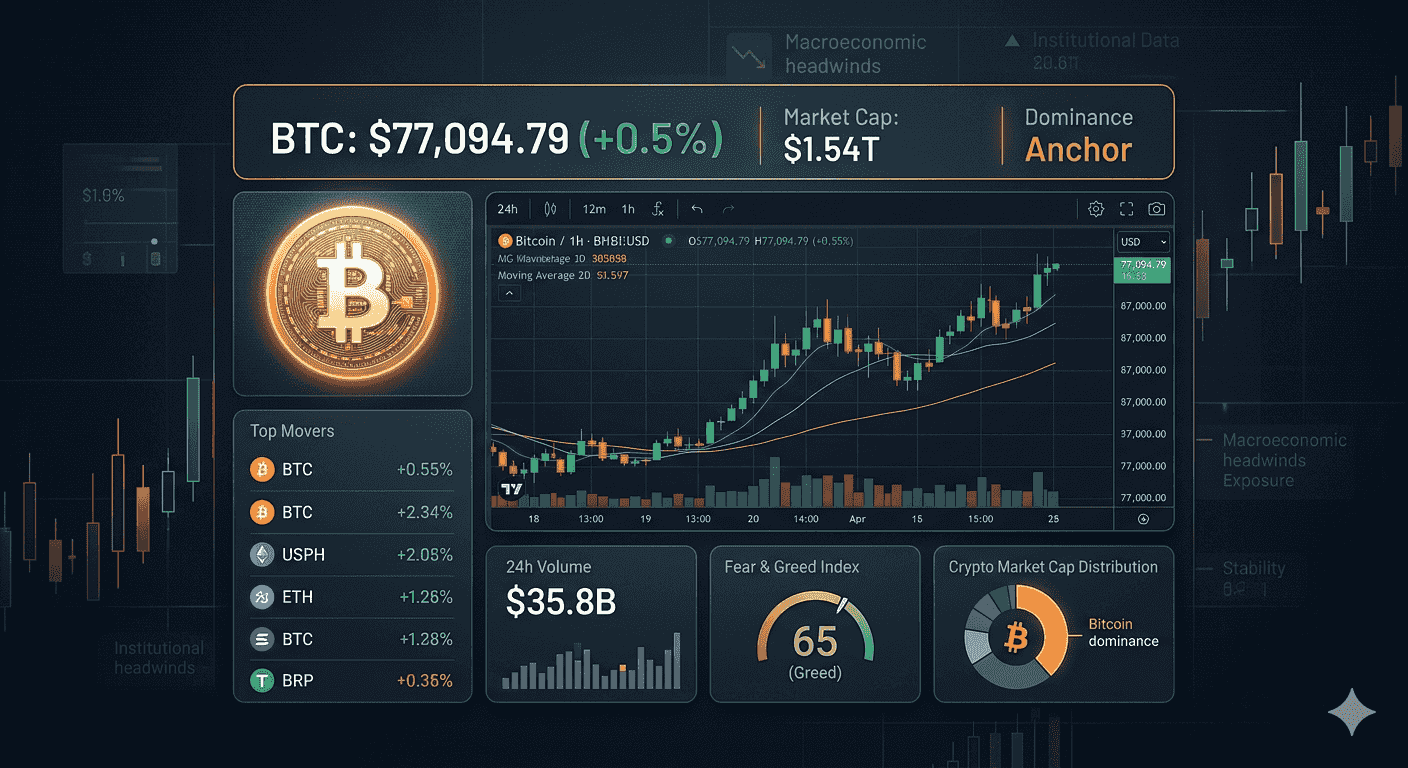
Bitcoin (BTC) is currently trading at approximately $77,094.79, reflecting a modest 24-hour gain of 0.5%. This short-term uptick occurs within a broader weekly context where BTC has seen a slight decline of 0.14%. Despite this minor weekly pullback, Bitcoin maintains a significant market capitalization of approximately $1.54 trillion, anchoring a total crypto market cap of over $2.06 trillion. This market dominance underscores Bitcoin's role as the bellwether asset for the digital economy.
In comparison to Bitcoin's relatively contained movements, several altcoins have exhibited more pronounced volatility within the same 24-hour period. Among the priority assets, Zcash (ZEC) registered a notable gain of 4.57%, while Hyperliquid (HYPE) increased by 3.04%, and Near Protocol (NEAR) saw a 1.92% rise. These movements indicate pockets of independent strength in specific altcoins. However, other major assets have experienced declines, with Ethereum (ETH) down 0.71%, XRP down 0.69%, Solana (SOL) down 0.68%, and Bitcoin Cash (BCH) experiencing a more significant drop of 2.52% over the last 24 hours. The overall average 24-hour move across the broader market snapshot is approximately 0.72%, suggesting a mildly positive short-term bias across the selected asset basket, largely influenced by Bitcoin's stability and select altcoin gains.
Why Bitcoin Is Driving The Tape
Bitcoin's current market behavior and its relative resilience can be largely attributed to a confluence of macro-economic considerations and persistent institutional interest. Recent headlines highlight several factors that are influencing Bitcoin's narrative and price action.
One significant macro-economic theme revolves around the Federal Reserve's potential actions and the state of traditional bond markets. Reports indicate concerns about rising short-term bond yields and the hawkish stance of figures like Kevin Warsh, a pro-crypto candidate for Fed chair, which could revive fears of a December rate hike. Historically, expectations of higher interest rates have often created headwinds for risk assets, including cryptocurrencies. Conversely, an analyst from BitMEX suggests that "soaring bond prices" could signal a "structural" shift in traditional finance, potentially paving the way for a Bitcoin "supercycle" as fixed-income investors seek alternatives amidst perceived instability in government securities. These contrasting interpretations of macro signals underscore the uncertainty that Bitcoin's market structure is currently navigating.
On the institutional front, there is continued evidence of Bitcoin's deepening integration into traditional financial strategies. MicroStrategy, a prominent corporate holder of Bitcoin, has reportedly amassed a record $65 billion worth of BTC, showcasing a sustained accumulation strategy. This move by a publicly traded company reinforces the narrative of Bitcoin as a strategic treasury asset. Furthermore, broader institutional crypto adoption appears to be accelerating, with reports indicating that institutions are "tightening their grip on Bitcoin." This includes Tether expanding its Bitcoin holdings and other institutional players exploring opportunities within the digital asset space. These developments suggest a growing confidence in Bitcoin's long-term value proposition among sophisticated investors, potentially providing a floor for its price even amidst macro uncertainties.
Additionally, advancements in accessibility and utility, such as MoonPay's new application allowing users to buy cryptocurrencies, including Bitcoin, through ChatGPT, contribute to the asset's overall market relevance. While this particular development is more about retail accessibility, it reflects the ongoing expansion of crypto's reach and ease of use, which can indirectly support market interest in Bitcoin. The combination of these macro-economic interpretations and undeniable institutional accumulation efforts largely explains why Bitcoin is setting the tone for the broader crypto market.
How The Rest Of The Market Is Responding
The rest of the cryptocurrency market is exhibiting a mixed response to Bitcoin's leadership, characterized by both independent movements and a general sensitivity to the broader market sentiment set by BTC. While Bitcoin has shown modest positive movement in the last 24 hours, many large-cap altcoins have registered slight declines, indicating that BTC is either demonstrating relative strength or acting as a more defensive asset in the current environment.
Ethereum (ETH), the second-largest cryptocurrency by market cap, recorded a 24-hour decline of 0.71%, closely mirroring the negative performance seen in XRP (-0.69%) and Solana (SOL) (-0.68%). This suggests that while Bitcoin holds steady, the immediate momentum for some of the largest altcoins is lagging. BNB, another top-tier asset, managed a slight gain of 0.21%, indicating a degree of independence but still far less pronounced than the strongest movers.
The strongest 24-hour moves observed in the market snapshot are concentrated in specific altcoins, notably Zcash (ZEC) with a 4.57% increase, Hyperliquid (HYPE) gaining 3.04%, and Near Protocol (NEAR) rising 1.92%. These assets, particularly ZEC and HYPE, are identified among the top volatile assets. Zcash's significant move stands out, indicating potential asset-specific catalysts or renewed interest in privacy-focused cryptocurrencies, though the provided news signals do not directly link to these assets. Conversely, Bitcoin Cash (BCH) experienced a notable 2.52% decline over the same period, making it one of the most volatile assets on the downside.
The divergence between Bitcoin's mild positive performance and the slight retreats of other major altcoins suggests that capital may be consolidating around BTC, or that altcoins are more susceptible to profit-taking in a market seeking clearer direction. While select altcoins like ZEC, HYPE, and NEAR are showing strong individual performance, the overall trend among the larger altcoin ecosystem appears to be one of cautious reaction to Bitcoin's relatively stable, yet influential, price structure.
Conclusion and Risk Management
Bitcoin's current market posture reflects its established role as the foundational asset within the cryptocurrency ecosystem. Its price structure, characterized by relative stability over the past 24 hours and minor weekly fluctuations, stands in contrast to the more varied performance seen across altcoins. This suggests that Bitcoin is effectively setting the market's tone, with its movements and the catalysts influencing it having a ripple effect on other digital assets.
The primary drivers for Bitcoin's trajectory remain firmly rooted in macro-economic developments and institutional adoption. Interpretations of Federal Reserve policy, bond market dynamics, and the continued accumulation by entities like MicroStrategy and other institutional players are central to understanding Bitcoin's current strength and potential future movements. The market's mildly positive short-term bias, as observed across the selected asset basket, hints at an underlying resilience, largely attributed to Bitcoin's steady performance.
Looking ahead, the market's direction will likely continue to hinge on these key themes. A clearer resolution on macro-economic policy, particularly regarding interest rates, could provide more definitive direction for Bitcoin. Similarly, sustained or increased institutional inflows could reinforce Bitcoin's position and potentially catalyze broader market upside.
For market participants, effective risk management in this environment involves closely monitoring Bitcoin's price action and the fundamental catalysts driving it. While certain altcoins may offer opportunities for higher volatility and returns, their movements are often influenced by Bitcoin's overarching trend. Investors should consider the potential for continued sensitivity to macro-economic shifts, which could introduce volatility across the market, and the implications of institutional sentiment on Bitcoin's stability. Diversification and a clear understanding of individual asset narratives, alongside Bitcoin's dominant role, remain crucial for navigating the evolving crypto landscape.
Source Data Reference
Market Snapshot Input
| Asset | Symbol | Price (USD) | 24h Change | Market Cap (USD) |
|---|---|---|---|---|
| Bitcoin | BTC | 77,094.785698 | 0.50% | 1,544,516,936,675 |
| Near Protocol | NEAR | 2.412846 | 1.92% | 2,859,621,232 |
| Hyperliquid | HYPE | 62.459555 | 3.04% | 20,857,005,599 |
| Zcash | ZEC | 663.145963 | 4.57% | 10,828,025,663 |
| XRP | XRP | 1.351582 | -0.69% | 83,606,608,590 |
| Solana | SOL | 85.285198 | -0.68% | 49,303,253,913 |
| Ethereum | ETH | 2,103.493968 | -0.71% | 253,316,029,327 |
| Bitcoin Cash | BCH | 347.220457 | -2.52% | 6,897,807,646 |
| Ondo | ONDO | 0.437215 | 1.53% | 1,381,209,757 |
| BNB | BNB | 657.878122 | 0.21% | 91,566,399,277 |
Trending Headlines Input
- Why is Bitcoin falling despite pro-crypto Kevin Warsh becoming Fed chair?
- Soaring bond prices signal 'structural' shift and Bitcoin 'supercycle': Analyst
- Blockchain researcher defends Ethereum Foundation, says it’s doing ‘exactly’ its job
- Strategy Now Holds $65 Billion in Bitcoin—These Are Its Biggest BTC Buys
- Crypto Biz: Institutions tighten their grip on Bitcoin, AI and prediction markets
- Now You Can Buy Bitcoin, XRP and More in ChatGPT via MoonPay