Bitcoin Price Structure
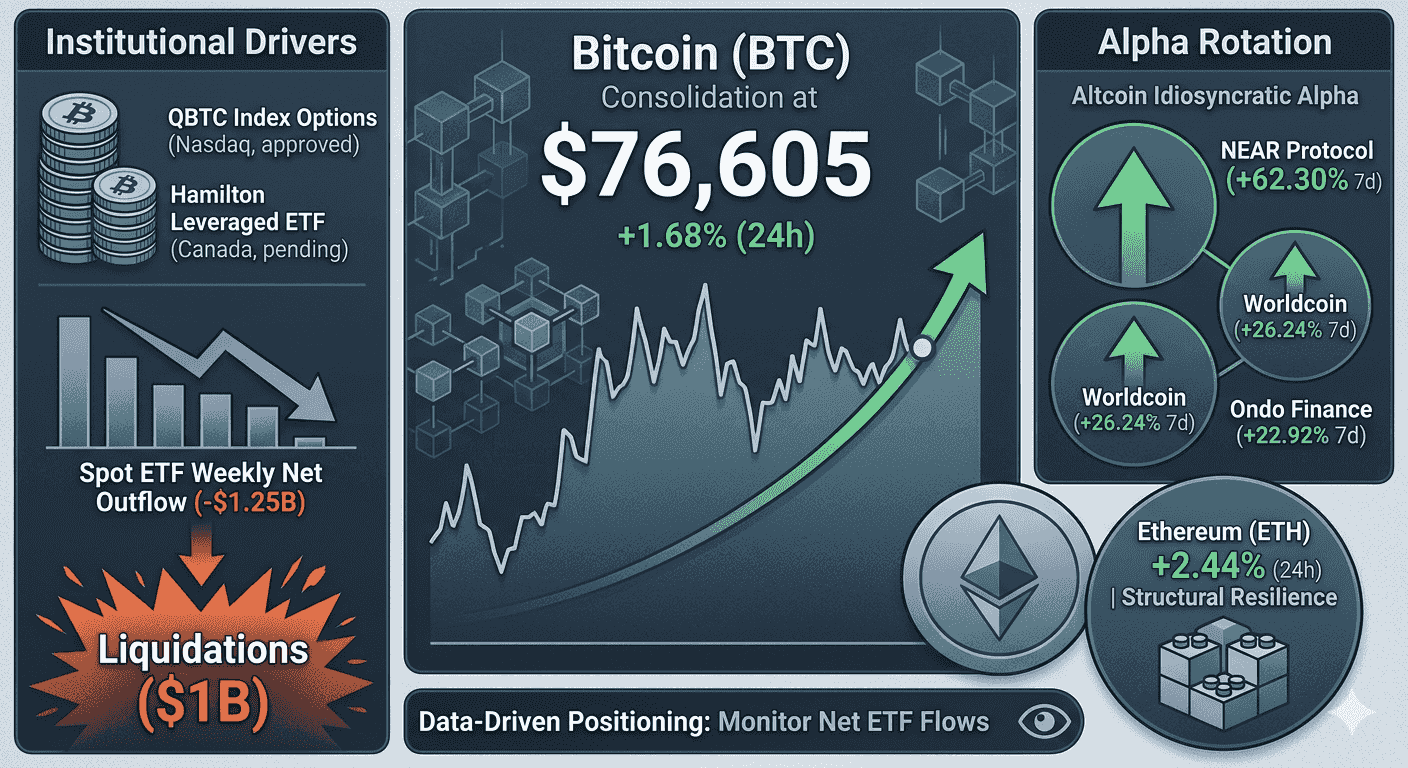
Bitcoin (BTC), the largest cryptocurrency by market capitalization, is currently trading at approximately $76,605.44. Over the past 24 hours, BTC has registered a modest gain of 1.68%. This short-term positive movement follows a more challenging period, as evidenced by a 7-day decline of 1.87%. Bitcoin's market capitalization stands at an impressive $1.53 trillion, contributing significantly to the total global crypto market cap of $2.01 trillion. This dominance highlights its critical role in the broader digital asset ecosystem.
While the 24-hour gain indicates a degree of resilience or a short-term bounce, it is noteworthy that Bitcoin's percentage increase is below the average 24-hour move observed across a broader basket of assets, which stands at approximately 6.07%. This suggests that while Bitcoin is holding its ground, it is not currently leading in terms of percentage-based upward momentum compared to some more volatile segments of the market. Its substantial market capitalization naturally lends itself to more tempered percentage movements than smaller, more speculative assets. The recent dip below $75,000, as reported, underscores the sensitivity of its price to significant capital shifts, particularly from institutional vehicles.
Why Bitcoin Is Driving The Tape
The primary catalysts shaping Bitcoin's current trajectory and, by extension, the wider crypto market, are predominantly linked to institutional adoption, regulatory progress, and the corresponding capital flows. Several recent developments illustrate this influence:
A significant positive signal for institutional engagement comes from the SEC's approval for Nasdaq to list Bitcoin index options on the exchange. These cash-settled, European-style contracts, which will trade under the ticker QBTC on Phlx, represent a further maturation of Bitcoin as an investable asset class. While trading still awaits CFTC approval, this regulatory nod from the SEC is a crucial step towards providing sophisticated financial instruments for institutional investors to gain exposure to Bitcoin's price movements without direct ownership. This development suggests a growing acceptance of Bitcoin within traditional financial frameworks.
Further reinforcing the trend of institutional product development, Hamilton ETFs has filed for a leveraged Bitcoin income ETF in Canada. This proposed fund aims to generate monthly income through covered-call and short-term options strategies, combined with leveraged Bitcoin exposure. Such offerings cater to a different segment of institutional demand, seeking both growth and yield from Bitcoin-linked products. The expansion of diverse ETF structures in regulated markets like Canada often serves as a precursor or a parallel development to similar products in larger markets, signaling sustained institutional interest.
However, the market has also witnessed pressures that underscore Bitcoin's sensitivity to institutional flows. News reports indicate that Bitcoin recently dipped below $75,000 for the first time in a month, coinciding with crypto liquidations nearing $1 billion. This price action was directly attributed to a challenging week for Bitcoin ETFs, which reportedly shed over $1.25 billion. This observed fact clearly demonstrates the immediate impact of institutional capital movements on Bitcoin's price structure. Outflows from these investment vehicles can create significant selling pressure, highlighting the interconnectedness between traditional finance's embrace of Bitcoin and its market valuation.
On the regulatory front, while less directly market-moving in the short term, the ongoing legal situation involving Bitcoin ATM firm CoinFlip, which is facing a lawsuit from Missouri alleging facilitation of fraudulent transactions, serves as a reminder of the broader regulatory scrutiny facing the crypto industry. Such incidents, while not directly impacting Bitcoin's core technology or institutional adoption narratives, contribute to the overall regulatory environment that affects how Bitcoin-related services operate and are perceived by the public and policymakers.
Collectively, these events—ranging from new financial product approvals to significant capital outflows and ongoing regulatory challenges—illustrate that Bitcoin's market direction is currently being heavily influenced by its integration into and interaction with traditional financial and regulatory systems.
How The Rest Of The Market Is Responding
Against the backdrop of Bitcoin's movements and institutional drivers, the broader cryptocurrency market is exhibiting a mixed response, with some assets mirroring BTC's moderate gains and others demonstrating significantly higher volatility. The overall market overview suggests a mildly positive short-term bias across the selected asset basket.
Ethereum (ETH), the second-largest cryptocurrency, has shown a 24-hour gain of 2.44%, trading at approximately $2,114.41. While outperforming Bitcoin slightly in the immediate 24-hour window, ETH has also experienced a 7-day decline of 3.11%, indicating it too has faced downward pressure over the past week, albeit less severe than Bitcoin's recent dip below $75K. News commentary suggests that Ethereum's dominance in DeFi, stablecoins, and staking continues to strengthen the long-term ETH accumulation thesis, despite its price decline in 2026. This indicates that fundamental protocol developments and ecosystem growth might be providing a different kind of support for Ethereum compared to Bitcoin's institutional ETF-driven narrative.
Among other major assets, XRP recorded a 24-hour increase of 1.72%, closely aligning with Bitcoin's performance, but also showing a 7-day loss of 3.96%. BNB saw a modest 0.93% gain in 24 hours and a slight 7-day increase of 0.41%. In contrast, Bitcoin Cash (BCH) experienced a 24-hour decline of 1.14% and a significant 7-day drop of 14.58%, indicating a divergence from the broader market's short-term positive bias.
The most pronounced movements within the market are concentrated in a few altcoins, as highlighted by the strongest 24-hour moves being observed in Near Protocol (NEAR), Worldcoin (WLD), and Ondo (ONDO).
- Near Protocol (NEAR) has surged by 16.12% in the last 24 hours and an impressive 62.30% over seven days, trading at $2.42.
- Worldcoin (WLD) recorded a 12.55% increase in 24 hours and a 26.24% rise over seven days, priced at $0.30.
- Ondo (ONDO) also saw an 11.51% jump in 24 hours and a 22.92% rally over the week, reaching $0.42.
These significant rallies in specific altcoins suggest that while Bitcoin's institutional narrative and capital flows are critical for the overall market structure, individual altcoins can experience substantial, project-specific driven momentum. This indicates a bifurcated market where capital can flow into high-conviction altcoin plays even as Bitcoin consolidates or experiences moderate price action. However, it is important to note that such strong altcoin performances often occur within a generally stable or mildly positive Bitcoin environment, as a sharp downturn in BTC typically impacts the entire market.
Conclusion and Risk Management
The current cryptocurrency market remains firmly anchored by Bitcoin, with its price structure and associated institutional catalysts serving as the primary drivers of overall direction. The recent approval of Bitcoin index options by the SEC and ongoing ETF developments in Canada underscore a persistent and growing institutional appetite for Bitcoin exposure. However, the observed price dip below $75,000, directly linked to significant ETF outflows, serves as a clear reminder of how sensitive Bitcoin's valuation is to the ebb and flow of institutional capital.
While the broader market shows a mildly positive short-term bias, and certain altcoins like NEAR, WLD, and ONDO are exhibiting strong independent rallies, the stability and trajectory of Bitcoin largely dictate the environment in which these altcoin movements can thrive. A sustained period of institutional outflows from Bitcoin ETFs could exert significant downward pressure across the market, potentially dampening altcoin enthusiasm.
For market participants, effective risk management in this Bitcoin-led environment involves closely monitoring institutional capital flows into and out of Bitcoin-linked financial products. Regulatory developments, particularly those concerning new Bitcoin financial instruments, will continue to be critical indicators. The need for CFTC approval for Nasdaq's Bitcoin options, for instance, introduces a potential point of delay or uncertainty. While altcoins can offer higher percentage gains, their volatility often means they are more susceptible to broader market downturns initiated by Bitcoin. Therefore, a balanced approach that acknowledges Bitcoin's foundational role while selectively evaluating altcoin-specific narratives appears prudent. The market's current state suggests a complex interplay of institutional adoption, regulatory oversight, and project-specific momentum, all under the overarching influence of Bitcoin.
Source Data Reference
Market Snapshot Input
| Asset | Symbol | Price (USD) | 24h Change | Market Cap (USD) |
|---|---|---|---|---|
| Bitcoin | BTC | 76,605.440399 | 1.68% | 1,534,682,061,328 |
| Near Protocol | NEAR | 2.415113 | 16.12% | 2,862,308,829 |
| Hyperliquid | HYPE | 58.764975 | 7.80% | 19,623,281,271 |
| Zcash | ZEC | 627.936277 | 7.04% | 10,253,112,452 |
| Ondo | ONDO | 0.42106 | 11.51% | 1,330,172,914 |
| Ethereum | ETH | 2,114.409183 | 2.44% | 254,630,508,396 |
| Worldcoin | WLD | 0.302361 | 12.55% | 1,032,424,802 |
| Bitcoin Cash | BCH | 355.06266 | -1.14% | 7,053,599,173 |
| XRP | XRP | 1.357399 | 1.72% | 83,966,444,235 |
| BNB | BNB | 655.800117 | 0.93% | 91,277,173,374 |
Trending Headlines Input
- Hamilton ETFs files for leveraged Bitcoin income ETF in Canada
- SEC approves Nasdaq to list Bitcoin index options on the exchange
- Bitcoin ATM Firm CoinFlip Blasts 'Meritless' Lawsuit as Missouri Demands Restitution for Seniors
- Bitcoin Dives Below $75K for First Time in a Month as Crypto Liquidations Near $1 Billion
- Ethereum is still a good long-term buy, according data: Analyst
- Verus bridge exploiter returns $8.5M after bounty offer