Bitcoin Price Structure
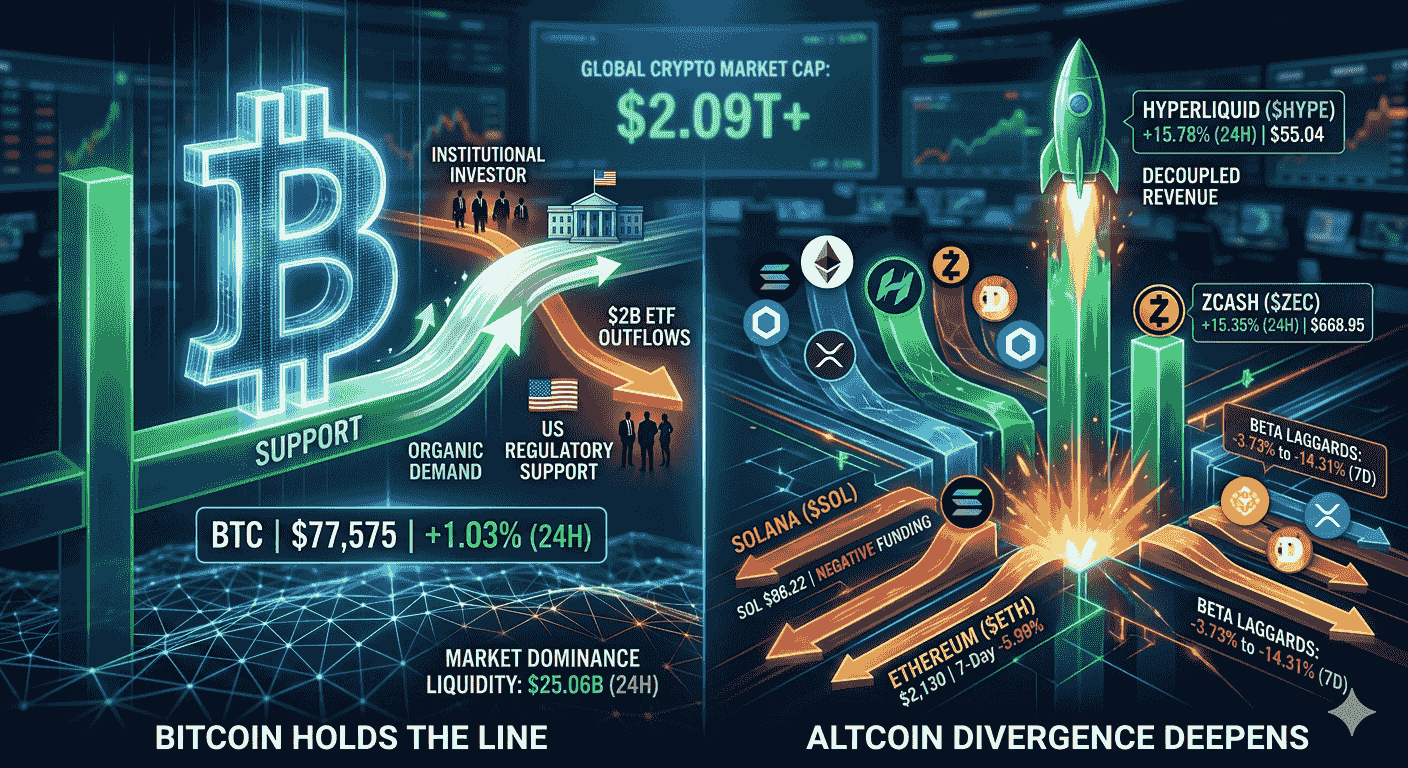
Bitcoin (BTC) is presently trading at approximately $77,575, reflecting a 24-hour price increase of 1.03%. This short-term gain comes despite a 7-day decline of 2.52%, indicating a recent stabilization or minor rebound after a period of downward pressure. As the undisputed leader, Bitcoin maintains a commanding market capitalization of approximately $1.55 trillion, contributing significantly to the global crypto market cap of over $2.09 trillion. Its 24-hour trading volume stands at around $25.06 billion, underscoring its liquidity and active trading interest.
Observed facts suggest that Bitcoin's current price action is characterized by a modest daily uptick following a more significant weekly retracement. Its position as the top-ranked asset by market capitalization remains unchallenged, solidifying its role as the primary benchmark for the cryptocurrency ecosystem. Interpretation suggests that while the asset has experienced some short-term headwinds over the past week, its ability to post a positive 24-hour return indicates underlying demand or a temporary pause in selling pressure. Compared to the average 24-hour move across the top assets, which is approximately 4.14%, Bitcoin's 1.03% gain is relatively subdued, suggesting a period of consolidation rather than aggressive expansion.
Why Bitcoin Is Driving The Tape
Bitcoin's market influence is being shaped by a confluence of institutional and regulatory catalysts, as evidenced by recent news signals. A significant factor is the performance of spot Bitcoin Exchange-Traded Funds (ETFs). Despite Bitcoin's recent rally through the $77,000 mark, the market has observed substantial outflows from these spot BTC ETFs, reportedly topping $2 billion. This presents a nuanced picture: Bitcoin's price appreciation in the face of such outflows suggests robust organic demand or buying pressure from other segments of the market, potentially offsetting the institutional selling. This divergence between ETF flows and price action indicates that the narrative around institutional adoption is evolving, with multiple facets influencing market dynamics beyond mere capital inflows.
On the regulatory front, the landscape is becoming increasingly favorable for Bitcoin in certain jurisdictions. South Carolina's governor recently signed a bill that protects Bitcoin miners from discriminatory zoning and licensing rules, while also banning Central Bank Digital Currency (CBDC) payments by state agencies. This legislative move is a clear positive for Bitcoin, as it fosters a more conducive environment for its underlying infrastructure (mining) and signals a preference for decentralized digital assets over state-controlled alternatives. Such developments can bolster confidence in Bitcoin's long-term viability and adoption within the United States.
Furthermore, a report from Citi highlighted a potential long-term risk for both Bitcoin and Ethereum: quantum computing. While both face this threat, Citi's analysis points to governance as a differentiating factor, suggesting that Bitcoin might face greater risks due to its governance structure. This is a forward-looking concern, but it underscores the ongoing need for protocol-level innovation and risk assessment, even for established assets. While not an immediate market driver, such discussions contribute to the broader narrative around Bitcoin's technological robustness and future resilience.
In summary, Bitcoin's current market leadership is being driven by its ability to absorb institutional selling pressure from ETFs, coupled with positive regulatory developments that enhance its operational environment. These factors, alongside ongoing discussions about its long-term technological security, collectively position Bitcoin as the central focus for market direction.
How The Rest Of The Market Is Responding
The broader cryptocurrency market is largely reacting to Bitcoin's lead, with a mixed bag of performance among altcoins. The overall market shows a mildly positive short-term bias, as indicated by derived insights, but this is not uniform across all assets. While Bitcoin posted a modest 24-hour gain, some altcoins have shown significant independent volatility, while others have lagged.
Among the priority assets, Hyperliquid (HYPE) and Zcash (ZEC) stand out for their exceptional performance. HYPE has surged by 15.78% in the last 24 hours and an impressive 41.63% over the past seven days, trading at approximately $55.04. News reports suggest that HYPE has decoupled from Bitcoin, boasting 101% year-to-date gains driven by exploding platform revenue. This indicates a strong project-specific momentum that is not directly tied to Bitcoin's immediate price movements, showcasing pockets of independent strength in the altcoin space. Similarly, Zcash (ZEC) has seen a 15.35% increase in 24 hours and a 27.09% rise over seven days, priced at around $668.95. These significant gains in HYPE and ZEC represent the strongest 24-hour moves among the top volatile assets.
In contrast, Solana (SOL), another priority asset, presents a more tempered picture. While SOL recorded a 2.30% gain in the last 24 hours, its 7-day performance shows a 5.45% decline, with its price around $86.22. News concerning Solana indicates that its futures funding rate has turned negative, raising questions about sustained demand and potential for further price drops towards $78. This suggests that despite Bitcoin's recent resilience, not all altcoins are experiencing uniform positive momentum, with some facing specific headwinds.
Other major cryptocurrencies have largely mirrored Bitcoin's more subdued positive movement or continued their weekly declines. Ethereum (ETH), the second-largest asset, recorded a slight 0.80% gain over 24 hours, but a 5.99% drop over seven days, trading at roughly $2,130. BNB, XRP, Dogecoin (DOGE), Bitcoin Cash (BCH), and Chainlink (LINK) all showed modest 24-hour gains ranging from 0.92% to 1.61%, yet all experienced negative performance over the 7-day period, ranging from -3.73% to -14.31%. This general trend indicates that while Bitcoin's recent daily uptick provided some relief, the broader market, particularly the larger altcoins, is still contending with the downward pressure seen over the past week, mostly lagging behind Bitcoin's more stable positioning. The market's overall "mildly positive short-term bias" appears to be heavily influenced by Bitcoin's stability and the outlier performance of a few specific altcoins like HYPE and ZEC, rather than a broad-based altcoin rally.
Conclusion and Risk Management
Bitcoin continues to assert its dominance, acting as the primary barometer for the cryptocurrency market. Its ability to maintain price stability and even post modest gains despite significant spot ETF outflows underscores a resilient demand base, potentially driven by factors beyond the immediate institutional investment vehicles. Positive regulatory developments, such as the bill in South Carolina, further strengthen Bitcoin's foundational narrative and long-term prospects.
Looking ahead, the market's direction will likely remain tethered to Bitcoin's performance and the evolving interplay of institutional capital flows and regulatory clarity. While the derived insights suggest a mildly positive short-term bias across the editorial asset basket, this positivity is not evenly distributed. Pockets of strong, independent altcoin performance, like that seen in HYPE and ZEC, demonstrate that specific project developments can still drive significant returns, potentially decoupling from Bitcoin's immediate movements. However, the majority of the larger altcoins appear to be consolidating or lagging, indicating that a broad-based bullish market requires stronger, more sustained momentum from Bitcoin itself.
For market participants, risk management remains paramount. While Bitcoin's resilience is notable, the persistent ETF outflows represent a potential headwind that could exert further pressure if not offset by other buying demand. Macroeconomic factors and broader market sentiment will also continue to play a role. Furthermore, long-term technological risks, such as the potential impact of quantum computing on cryptographic security, warrant ongoing monitoring. Investors should consider Bitcoin's foundational role and its ongoing battle between institutional pressures and organic demand as key indicators, while carefully evaluating the distinct risk-reward profiles of altcoins that may or may not be directly confirming Bitcoin's trajectory. Diverse strategies that account for both Bitcoin's leadership and altcoin-specific narratives will be crucial in navigating the current market environment.
Source Data Reference
Market Snapshot Input
| Asset | Symbol | Price (USD) | 24h Change | Market Cap (USD) |
|---|---|---|---|---|
| Bitcoin | BTC | 77,574.99969 | 1.03% | 1,553,997,908,787 |
| Hyperliquid | HYPE | 55.035025 | 15.78% | 18,377,745,694 |
| Zcash | ZEC | 668.95029 | 15.35% | 10,922,800,275 |
| Solana | SOL | 86.217288 | 2.30% | 49,815,455,832 |
| Ethereum | ETH | 2,130.220904 | 0.80% | 256,534,655,794 |
| Bitcoin Cash | BCH | 372.934247 | 1.08% | 7,408,632,308 |
| Dogecoin | DOGE | 0.103812 | 0.94% | 15,483,294,457 |
| BNB | BNB | 650.141486 | 1.61% | 90,489,579,915 |
| XRP | XRP | 1.36821 | 0.92% | 84,595,113,436 |
| Chainlink | LINK | 9.636186 | 1.60% | 6,040,442,941 |
Trending Headlines Input
- Solana futures funding rate turns negative: Is $78 SOL next?
- HYPE Surges 101% This Year: What’s Driving Hyperliquid’s Growth?
- South Carolina governor signs bill protecting Bitcoin miners, banning CBDC
- Bitcoin rallies through $77K despite spot BTC ETF outflows topping $2B
- Bitcoin Faces Greater Quantum Computing Risk Than Ethereum, Citi Warns
- Shai-Hulud: What to Know About the Malware Spreading Through Software Pipelines