Bitcoin Price Structure
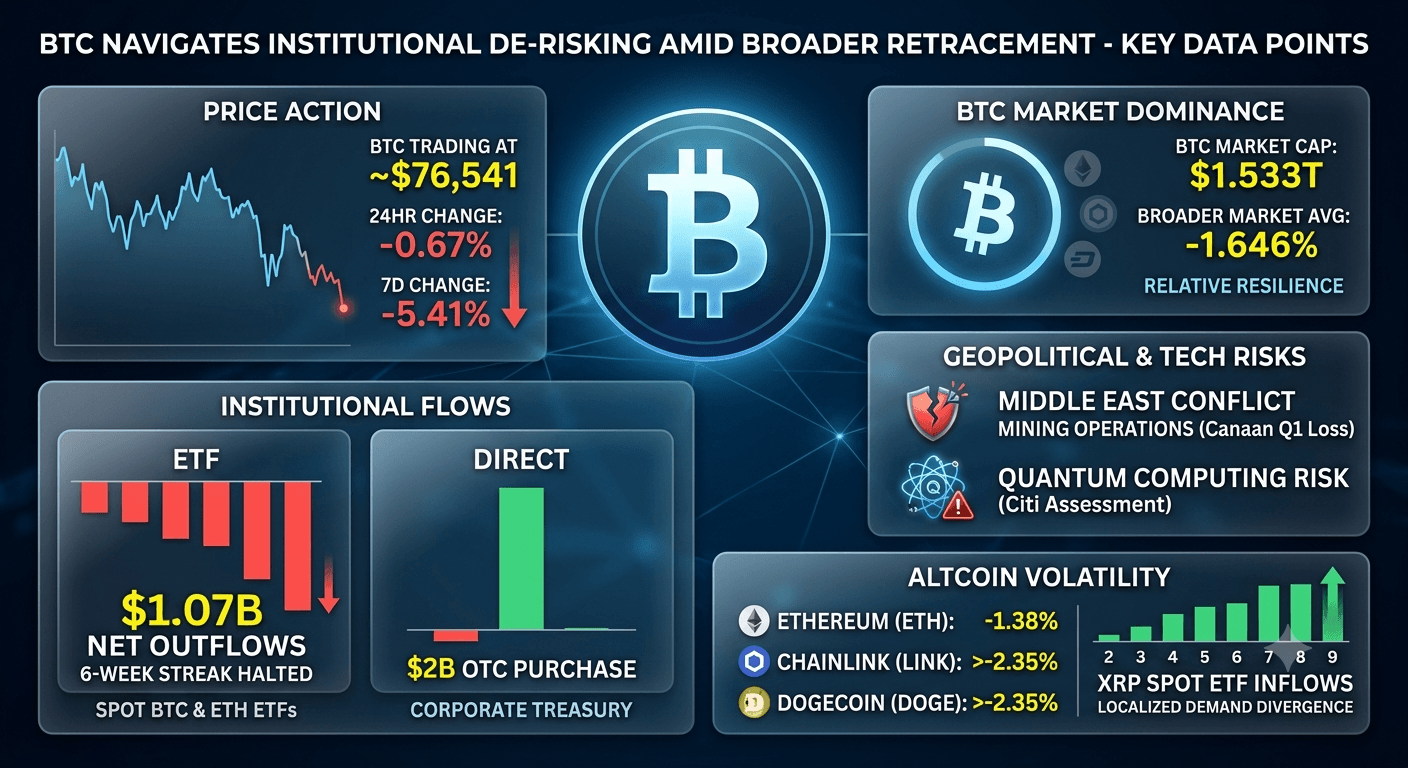
Bitcoin, the leading cryptocurrency by market capitalization, is trading at approximately $76,541.07. Over the last 24 hours, BTC has seen a modest decline of -0.67%. Looking at the weekly performance, Bitcoin has shed -5.41%. Despite these short-term movements, Bitcoin's dominant position remains unchallenged, with a market capitalization of $1.533 trillion contributing significantly to the overall crypto market cap of $2.062 trillion. Its 24-hour trading volume stands at $25.78 billion.
A key observation in the current environment is Bitcoin's relative resilience compared to the broader market. While Bitcoin registered a -0.67% dip over the past 24 hours, the average 24-hour price change across a selected basket of assets was a more pronounced -1.646%. This suggests that while the market is broadly pulling back, Bitcoin is demonstrating a degree of relative strength or a slower rate of decline compared to many altcoins. This positioning indicates that capital may be consolidating in or rotating towards the perceived safety of the largest digital asset during periods of uncertainty.
Why Bitcoin Is Driving The Tape
Bitcoin's current market behavior is intricately linked to a combination of institutional flow dynamics, macroeconomic considerations, and emerging technological risk assessments. These factors collectively create a complex backdrop that investors are navigating.
A significant development impacting Bitcoin's recent performance is the shift in institutional investment flows. Reports indicate that Bitcoin and Ethereum Exchange-Traded Funds (ETFs) have collectively shed $1.07 billion, marking an end to a six-week streak of inflows into crypto funds. This outflow suggests a cooling of institutional enthusiasm or a strategic de-risking by larger players, potentially in response to broader market conditions or profit-taking after recent rallies. This observed "bleed" from ETFs is a direct, quantifiable bearish signal that has contributed to Bitcoin's recent downward pressure.
However, the institutional narrative is not entirely one-sided. Despite the ETF outflows, there are indications of continued institutional interest at a more direct level. One report highlighted that Bitcoin had lost its hold on the $80,000 mark but also pointed to events that could send it back, specifically mentioning a $2 billion BTC purchase by "Strategy." While the specific entity is not detailed, such large-scale direct acquisitions by institutional players can provide underlying support and signal long-term conviction, potentially absorbing some of the sell pressure from ETF redemptions.
Macroeconomic and geopolitical factors are also playing a role in shaping Bitcoin's outlook. The CEO of Bitcoin mining company Canaan cited the Middle East conflict as clouding the outlook for Bitcoin miners, leading to a plunge in Canaan's shares and an $88.7 million net loss for the company in Q1. This illustrates how real-world geopolitical instability can directly impact the profitability and operational environment of the Bitcoin ecosystem, contributing to a cautious market sentiment. Furthermore, discussions around "crumbling investor confidence in the US Treasury" and a "potential US-Iran deal" are being posited as potential catalysts that could influence Bitcoin's appeal as a hedge against traditional financial instability, though their immediate impact remains speculative.
Adding another layer of consideration, a recent warning from Citi suggests that Bitcoin faces a greater quantum computing risk than Ethereum. While this is a more long-term, protocol-level concern rather than an immediate price driver, such assessments from major financial institutions can influence the long-term perception of Bitcoin's security and resilience, particularly among risk-averse institutional investors. This highlights the ongoing evolution of risk factors in the digital asset space.
In summary, Bitcoin's current trajectory is being shaped by the tangible impact of institutional ETF outflows, which signal a short-term reduction in demand. This is juxtaposed with continued direct institutional buying and a backdrop of macroeconomic and geopolitical uncertainties that could, paradoxically, enhance Bitcoin's appeal as a non-sovereign asset, creating a complex and somewhat conflicting set of drivers.
How The Rest Of The Market Is Responding
The broader cryptocurrency market is largely responding to Bitcoin's lead, generally confirming the downward trend, often with amplified volatility. The derived insights indicate that the selected asset basket exhibits a mildly negative short-term bias, and the strongest 24-hour moves are concentrated in altcoins such as Chainlink (LINK), XRP, and Dogecoin (DOGE).
Ethereum (ETH), the second-largest cryptocurrency, is currently trading at $2,105.09. Its 24-hour change of -1.38% and 7-day change of -8.03% indicate that it is underperforming Bitcoin in the short term. The news regarding institutional ETF outflows explicitly mentioned both Bitcoin and Ethereum, suggesting that ETH funds also bore the brunt of recent institutional selling. On a separate note, Ethereum founder Vitalik Buterin's comments on AI verification for securing crypto networks point to ongoing protocol development, but this is less of an immediate price driver than the institutional flow data. Citi's assessment of Bitcoin facing greater quantum computing risk than Ethereum could be interpreted as a long-term comparative advantage for ETH, but it has not translated into immediate outperformance.
Among other priority assets, BNB is trading at $637.99, with a -1.10% change over 24 hours and a -5.36% change over seven days, also trailing Bitcoin's relative performance. XRP, at $1.35, recorded a -2.35% drop in 24 hours and a -6.15% decline over seven days, placing it among the more volatile assets. Interestingly, despite XRP's price struggles, news highlights a nine-day streak of net inflows into spot XRP ETFs, which is absorbing sell pressure and could potentially support a recovery over time. This illustrates a nuanced picture for XRP, where institutional demand exists but is currently battling broader market headwinds and inherent price risk. Bitcoin Cash (BCH) is trading at $369.69, experiencing a -2.16% drop in 24 hours and a significant -16.09% decline over the past week, making it one of the weaker performers among the larger assets.
Looking at the broader market's top volatile assets, Chainlink (LINK) saw a -2.45% decline, XRP a -2.35% decline, and Dogecoin (DOGE) also a -2.35% decline over 24 hours. These figures are all considerably larger than Bitcoin's -0.67% movement, reinforcing the observation that altcoins are generally more susceptible to downside volatility when Bitcoin experiences a pullback or when overall market sentiment turns cautious. This pattern suggests a "flight to quality" dynamic, where investors may be reducing exposure to higher-beta assets and concentrating capital in Bitcoin, or at least exiting altcoins at a faster rate.
Conclusion and Risk Management
Bitcoin is unequivocally setting the current tone for the cryptocurrency market. Its price structure, characterized by a modest retracement but relative strength against the broader market average, reflects a period of caution influenced by conflicting signals. The significant institutional outflows from Bitcoin and Ethereum ETFs underscore a recent shift in investor sentiment, indicating a period of de-risking or profit-taking. However, this is partially counterbalanced by reports of substantial direct institutional buying and the potential for macroeconomic uncertainties to bolster Bitcoin's safe-haven narrative.
The rest of the market, particularly major altcoins like Ethereum and BNB, and more volatile assets such as XRP, Chainlink, and Dogecoin, are largely confirming this cautious outlook. Many altcoins are experiencing more pronounced declines than Bitcoin, indicating a lower appetite for risk and a potential rotation of capital towards Bitcoin's relative stability. The unique situation of XRP, with ETF inflows despite price depreciation, suggests underlying demand that is currently being overshadowed by broader market forces.
Looking ahead, the market's direction will likely hinge on the evolution of institutional flows. A sustained return of ETF inflows could provide a strong bullish catalyst for Bitcoin, potentially enabling it to re-challenge higher price levels, including the $80,000 mark. Conversely, continued institutional outflows, exacerbated by unresolved geopolitical tensions or further macroeconomic headwinds, could exert additional downward pressure.
For market participants, effective risk management in this environment involves closely monitoring Bitcoin's price action and institutional flow data as key indicators. Given the amplified volatility observed in altcoins, a cautious approach to higher-beta assets may be warranted. Understanding Bitcoin's role as the primary market mover, and its sensitivity to both institutional sentiment and macro-geopolitical developments, will be crucial for navigating the market's near-term trajectory. The overall market exhibits a mildly negative short-term bias, suggesting that prudence and careful consideration of risk remain paramount.
Source Data Reference
Market Snapshot Input
| Asset | Symbol | Price (USD) | 24h Change | Market Cap (USD) |
|---|---|---|---|---|
| Bitcoin | BTC | 76,541.071647 | -0.67% | 1,533,249,468,807 |
| Ethereum | ETH | 2,105.094054 | -1.38% | 253,508,721,705 |
| XRP | XRP | 1.357634 | -2.35% | 83,941,233,280 |
| Bitcoin Cash | BCH | 369.689474 | -2.16% | 7,344,172,354 |
| Solana | SOL | 84.008267 | -1.67% | 48,539,166,274 |
| Hyperliquid | HYPE | 47.57155 | -0.54% | 15,885,481,034 |
| Dogecoin | DOGE | 0.102448 | -2.35% | 15,279,904,757 |
| Chainlink | LINK | 9.408346 | -2.45% | 5,897,621,163 |
| Cardano | ADA | 0.247584 | -1.79% | 9,566,940,958 |
| BNB | BNB | 637.996444 | -1.10% | 88,799,179,067 |
Trending Headlines Input
- Bitcoin, Ethereum ETFs Bleed as Crypto Funds Shed $1.07 Billion, Ending 6-Week Win Streak
- XRP price risks 50% drop despite 9-day ETF inflow streak
- Bitcoin lost its hold on $80K, but three events may send it back sooner than markets expect
- Ethereum Founder Vitalik Buterin Says AI Verification Could Help Secure Crypto Networks
- Canaan Shares Plunge as CEO Says Middle East Conflict Is Clouding Outlook for Bitcoin Miners
- Bitcoin Faces Greater Quantum Computing Risk Than Ethereum, Citi Warns