Bitcoin Price Structure
Bitcoin (BTC) is presently trading at approximately $77,055, experiencing a minor 24-hour decline of 0.19%. Looking at the past seven days, BTC has seen a more significant retraction of 5.33%. Despite this short-term dip, Bitcoin maintains its dominant position, accounting for a substantial portion of the total crypto market capitalization at $1.54 trillion. This strong market-cap weighting means that Bitcoin's movements are disproportionately influential on the broader market.
In comparison, other major assets have shown mixed performance. Ethereum (ETH), the second-largest cryptocurrency, is trading around $2,130, registering a 24-hour gain of 0.61%, yet it has recorded a 7-day decline of 8.46%. Solana (SOL) is at approximately $85.47, with a marginal 24-hour increase of 0.10% but a 7-day drop of 12.03%. XRP, priced at about $1.39, saw a 24-hour decrease of 0.26% and a 7-day fall of 5.73%. These figures indicate that while Bitcoin has shown some resilience in the immediate 24-hour window compared to its weekly performance, the overall trend for major cryptocurrencies over the past week has been downward, with Bitcoin's relatively smaller 24-hour movement suggesting a period of consolidation or mild weakness. The observed facts suggest that Bitcoin's current price structure is characterized by recent weekly corrections, but with short-term relative stability compared to some altcoins.
Why Bitcoin Is Driving The Tape
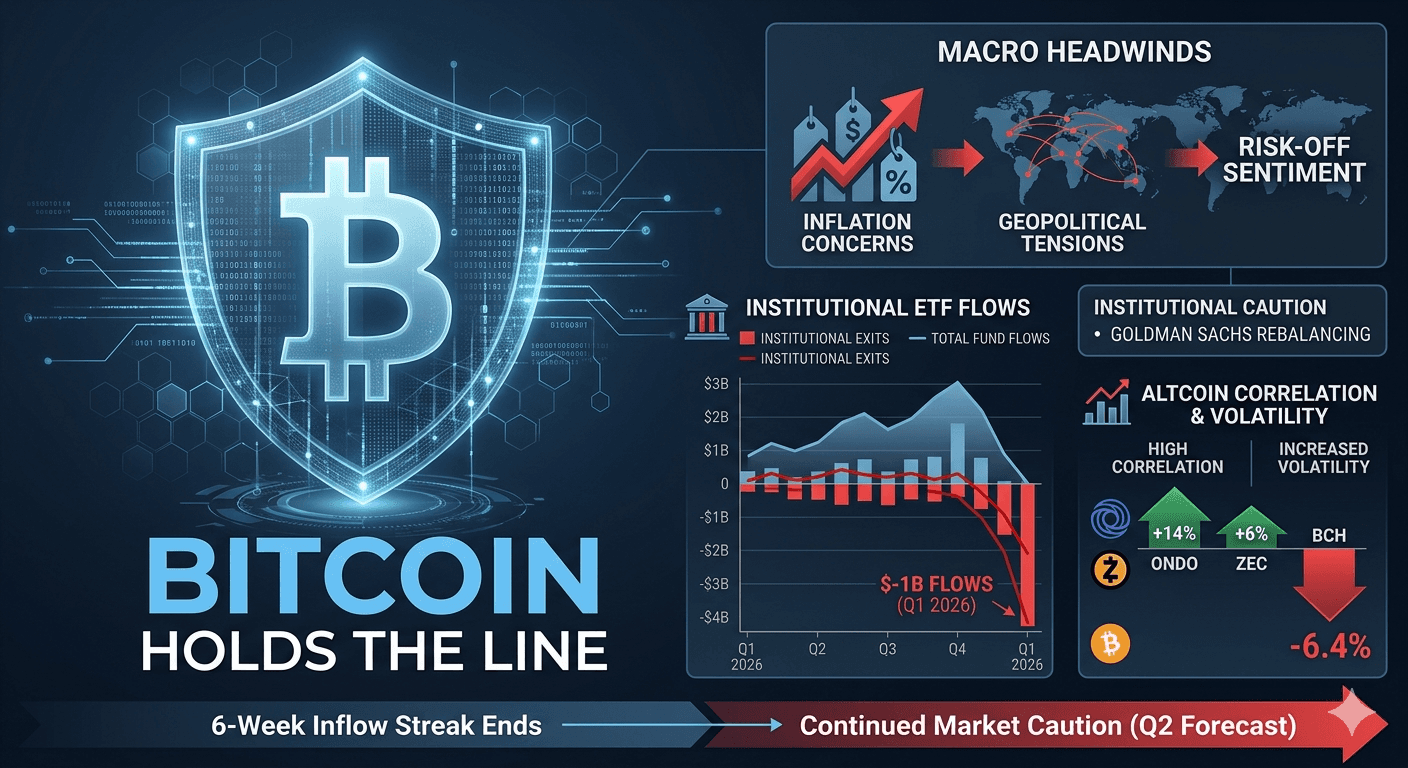
The current market dynamic, where Bitcoin largely sets the tone, appears to be heavily influenced by institutional investor behavior and broader macroeconomic factors. Recent reports highlight significant outflows from crypto investment products, with a notable $1 billion pulled from funds, effectively ending a six-week streak of inflows. Bitcoin and Ethereum exchange-traded funds (ETFs) bore the brunt of these withdrawals.
This institutional retrenchment is interpreted as a response to escalating geopolitical tensions, particularly those involving Iran, which have contributed to a broader "risk-off" sentiment across global financial markets. Rising inflation concerns further exacerbate this cautious approach, leading investors to de-risk their portfolios, including their crypto holdings. The fact that Bitcoin ETFs experienced the most substantial outflows underscores Bitcoin's role as a primary barometer for institutional engagement in the crypto space.
Adding to this narrative, Goldman Sachs reportedly exited its XRP and Solana ETF exposures in Q1 2026, while also trimming its Bitcoin and Ethereum ETF holdings. This move by a major financial institution signals a reassessment of crypto allocations, potentially driven by a more conservative outlook on digital assets in the current economic climate. While the specific reasons for Goldman Sachs's rebalancing are multifaceted, the overall trend points to institutional caution.
Furthermore, a significant legal development involving Swan Bitcoin, a Bitcoin-centric financial services firm, with a nearly $1 billion lawsuit related to the Prime Trust collapse, introduces an element of regulatory and operational risk within the Bitcoin ecosystem. Allegations of insider information use preceding major losses could impact institutional confidence in service providers within the Bitcoin space, even if the lawsuit is specific to one entity. These institutional and macro-linked catalysts collectively exert pressure on Bitcoin's price and market sentiment, reinforcing its role as the primary driver of current market direction.
How The Rest of the Market Is Responding
The broader crypto market is largely reacting to Bitcoin's lead, with varying degrees of correlation and independent movement. While Bitcoin has shown a slight 24-hour dip, the general trend among priority assets like Ethereum, Solana, and XRP has been a continuation of the weekly downturn. Ethereum, despite a marginal 24-hour gain, is down significantly over seven days, mirroring the institutional outflows seen in Bitcoin ETFs. News of a Verus Ethereum bridge exploit, reportedly resulting in an $11.6 million loss, introduces a specific security concern for the Ethereum ecosystem, potentially contributing to investor apprehension. Conversely, Vitalik Buterin's recent comments on AI verification potentially securing crypto networks represent a forward-looking development, but its immediate market impact is less clear amid current headwinds.
Solana and XRP, while experiencing minor 24-hour changes, have also recorded double-digit and mid-single-digit percentage declines over the past week, respectively. This suggests that the "risk-off" sentiment impacting Bitcoin is broadly affecting other large-cap assets, indicating a market-wide cautious approach rather than a rotation into altcoins. The observation that institutional investors pulled capital from Bitcoin and Ether products, while XRP and Solana funds continued to attract fresh inflows according to one news source, presents a mixed signal for these altcoins. However, another headline explicitly states Goldman Sachs exited XRP and Solana ETF exposure, indicating a more complex institutional picture for these assets. The prevailing sentiment appears to be one of caution, as evidenced by the overall negative weekly performance across most majors.
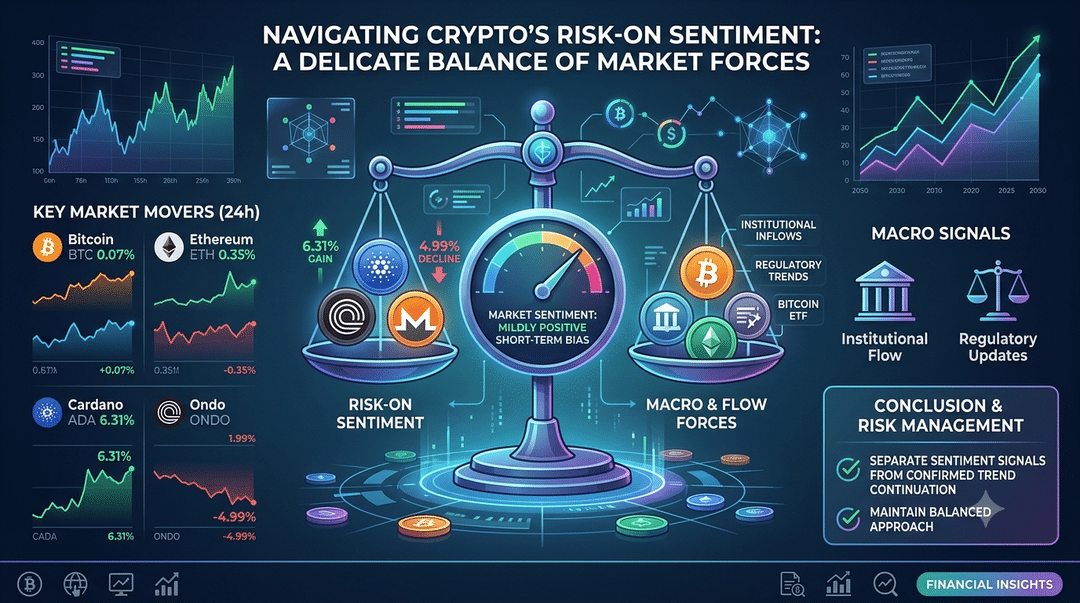
Amidst this backdrop, some altcoins have demonstrated significant independent volatility. Ondo (ONDO) has surged by nearly 14% in the last 24 hours, standing out as the top performer among tracked assets. Zcash (ZEC) also saw a notable gain of over 6% in the same period. In contrast, Bitcoin Cash (BCH) experienced a sharp decline of 6.4% over 24 hours. These movements, particularly in ONDO and ZEC, indicate that while the macro and institutional narratives are centered around Bitcoin and major altcoins, specific projects can still see substantial price action driven by idiosyncratic factors, though these are exceptions rather than the prevailing market trend. The strongest 24-hour moves are indeed concentrated in ONDO, BCH, and ZEC, confirming a degree of altcoin-specific volatility despite the broader market's Bitcoin-led caution.
Conclusion and Risk Management
The current cryptocurrency market environment is unequivocally shaped by Bitcoin's price structure and the prevailing sentiment among institutional investors. Bitcoin's relatively stable 24-hour performance, juxtaposed with a more significant weekly decline, reflects a market grappling with external pressures. The primary drivers behind this are clear: substantial institutional outflows from Bitcoin and Ethereum ETFs, largely attributed to escalating geopolitical tensions and persistent inflation concerns, which have fostered a "risk-off" environment. Major financial players like Goldman Sachs adjusting their crypto ETF exposures further underscore this cautious institutional stance.
Looking ahead, the market's trajectory will likely remain highly sensitive to these macro and institutional factors. Should geopolitical stability improve or inflation data show signs of easing, a potential reduction in risk aversion could see renewed institutional interest, potentially supporting Bitcoin's price. Conversely, any further escalation of tensions or sustained inflationary pressures could prolong the current period of caution, leading to continued outflows or sideways price action for Bitcoin.
For market participants, effective risk management in this Bitcoin-led environment involves closely monitoring not just on-chain metrics but also global macroeconomic indicators and institutional sentiment. Given the current data, a scenario where Bitcoin continues to consolidate or experiences further moderate declines appears plausible if the "risk-off" narrative persists. Investors should be prepared for potential volatility, particularly in altcoins, which may react more acutely to Bitcoin's movements or face project-specific challenges, as seen with the Ethereum bridge exploit. Diversification and careful position sizing remain crucial. The market's overall mildly positive short-term bias, as observed in the selected asset basket, should be interpreted within the context of Bitcoin's dominant influence and the prevailing institutional caution.
Source Data Reference
Market Snapshot Input
| Asset | Symbol | Price (USD) | 24h Change | Market Cap (USD) |
|---|---|---|---|---|
| Ethereum | ETH | 2,130.789651 | 0.61% | 256,603,147,821 |
| Bitcoin | BTC | 77,055.099157 | -0.19% | 1,543,512,112,528 |
| Solana | SOL | 85.469089 | 0.10% | 49,424,898,799 |
| XRP | XRP | 1.392037 | -0.26% | 86,068,292,798 |
| Bitcoin Cash | BCH | 377.497757 | -6.40% | 7,499,290,040 |
| Hyperliquid | HYPE | 48.181179 | 3.05% | 16,089,053,281 |
| Zcash | ZEC | 561.590222 | 6.14% | 9,169,796,208 |
| Ondo | ONDO | 0.390737 | 13.96% | 1,234,379,386 |
| Dogecoin | DOGE | 0.104782 | -1.89% | 15,627,965,664 |
| BNB | BNB | 644.345584 | -0.27% | 89,682,880,494 |
Trending Headlines Input
- Crypto funds see $1B in outflows as Iran tensions revive risk-off sentiment
- Goldman Sachs exits XRP, Solana ETF exposure in Q1 2026
- Bitcoin, Ethereum ETFs Bleed as Crypto Funds Shed $1.07 Billion, Ending 6-Week Win Streak
- Verus Ethereum bridge reportedly exploited for $11.6M in latest DeFi attack
- Ethereum Founder Vitalik Buterin Says AI Verification Could Help Secure Crypto Networks
- Swan Bitcoin Hit With Nearly $1 Billion Lawsuit Over Prime Trust Collapse