Bitcoin Price Structure
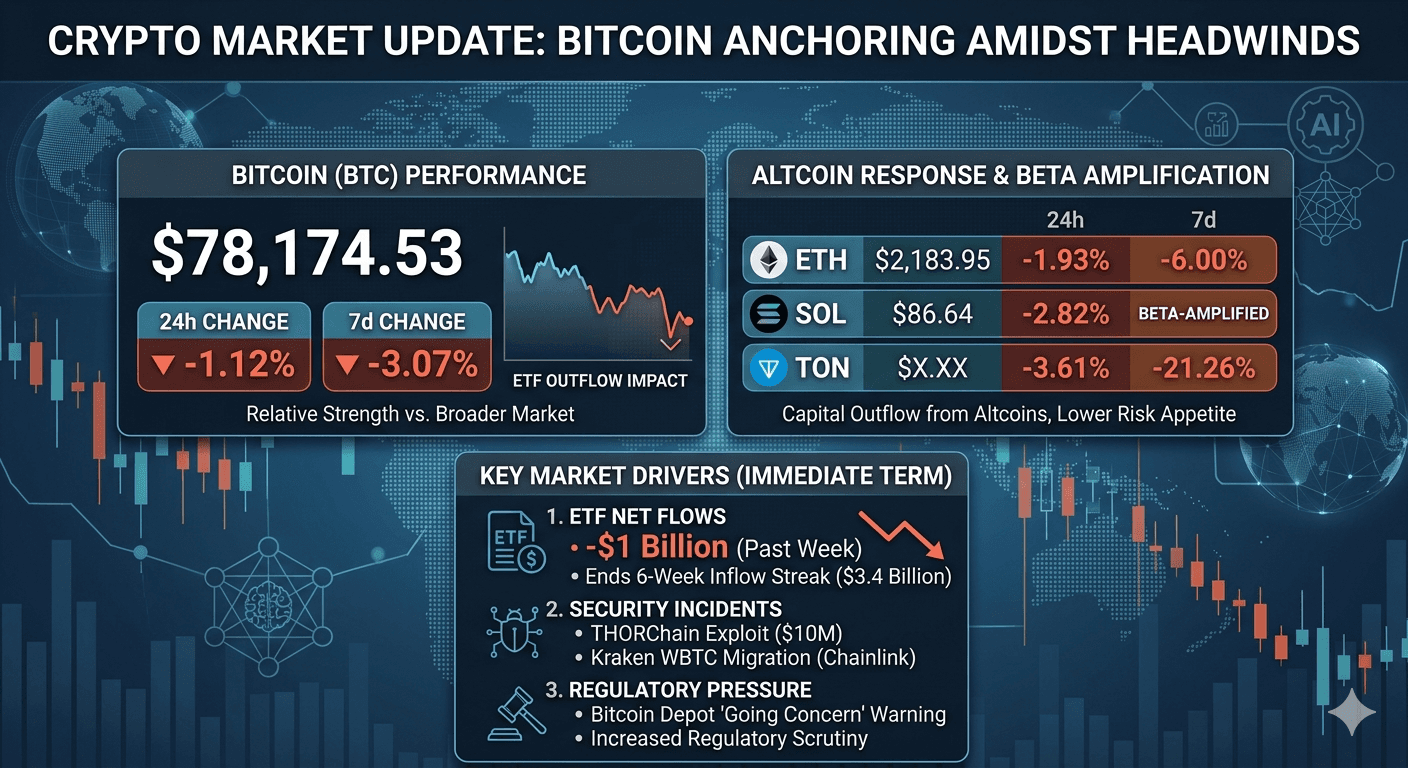
Bitcoin (BTC), the largest cryptocurrency by market capitalization, is observed trading at approximately $78,174.53. Over the past 24 hours, BTC has experienced a decline of -1.12%. This movement contributes to a more significant weekly downturn, with the asset down -3.07% over the last seven days. Despite these negative figures, Bitcoin's performance shows relative strength when compared to the average 24-hour move across the broader crypto market, which stands at -2.58%.
Bitcoin maintains a commanding market capitalization of approximately $1.56 trillion, underpinning its role as the primary bellwether for the digital asset space. Its 24-hour trading volume is reported at $22.18 billion, indicating sustained, albeit cautious, engagement from market participants. The observed price action suggests a period of consolidation, where Bitcoin is navigating significant external pressures with a degree of stability not uniformly reflected across the altcoin landscape. This relative strength in a generally negative market environment positions Bitcoin as the key determinant of overall market sentiment and direction.
Why Bitcoin Is Driving The Tape
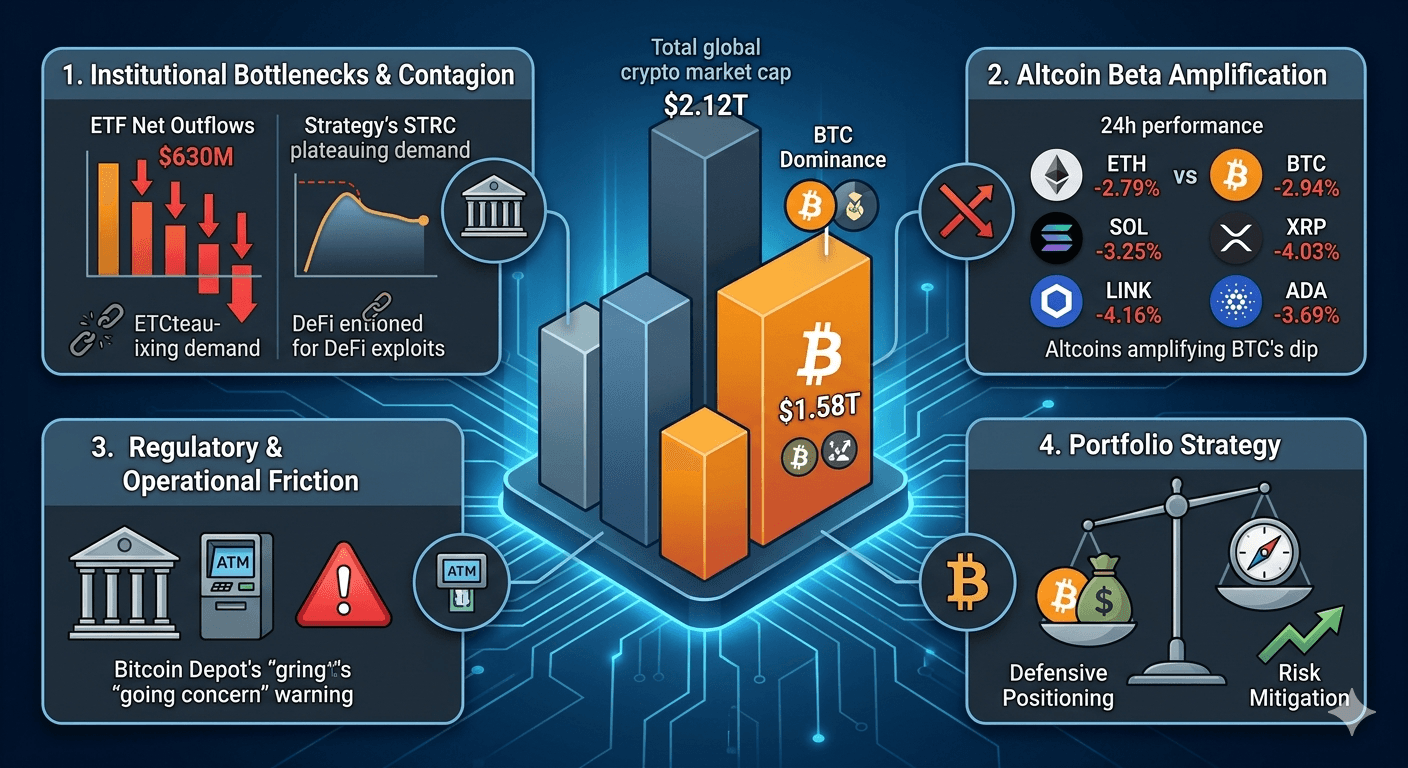
Bitcoin's current market influence is largely attributable to a confluence of institutional developments, security concerns, and regulatory narratives. A primary driver of recent price action has been the performance of spot Bitcoin Exchange-Traded Funds (ETFs). Observations indicate that these ETFs have collectively experienced a significant outflow, shedding $1 billion in capital over the past week, thereby ending a six-week streak of inflows that had previously attracted $3.4 billion. This shift in capital allocation, with some analysts attributing it to a rotation towards AI stocks and broader macro uncertainty, suggests a tempering of institutional enthusiasm in the immediate term. Reports further highlight outflows of $630 million, contributing to Bitcoin's dip below the $80,000 threshold. While some analysts suggest this dip could be "short-lived" in anticipation of potential future cycles, the immediate impact of ETF outflows is a clear headwind.
Beyond direct investment vehicles, security developments within the broader crypto ecosystem also have implications for Bitcoin. The recent news of THORChain pausing trading following a suspected $10 million exploit, spanning assets including Bitcoin, Ethereum, BNB Chain, and Base, underscores the interconnected security risks that can affect even the most established cryptocurrencies. Such incidents, while not directly targeting Bitcoin's core protocol, can dampen overall market confidence and highlight systemic vulnerabilities in cross-chain interactions that involve wrapped Bitcoin assets.
Furthermore, the regulatory and operational landscape for Bitcoin-related businesses is contributing to the narrative. Bitcoin Depot, a prominent crypto ATM company, has issued a filing that casts doubt on its future, citing financial difficulties amidst a changing regulatory environment and ongoing litigation. This "going concern" warning, signaling uncertainty over its ability to survive the next 12 months due to falling ATM revenue and growing regulatory scrutiny, reflects broader challenges faced by businesses operating at the interface of traditional finance and digital assets. While specific to one company, such developments can contribute to a cautious outlook on the ease of access and adoption of Bitcoin in certain jurisdictions, influencing investor perception.
Another notable development is Kraken's decision to migrate its Wrapped Bitcoin (WBTC) technology to Chainlink, moving away from LayerZero following a recent $292 million exploit involving Kelp DAO. This move, driven by security considerations, highlights the ongoing efforts within the industry to enhance the security and integrity of Bitcoin-linked assets, which is critical for maintaining trust and facilitating institutional participation.
Collectively, these factors—institutional ETF flows, ecosystem-wide security concerns impacting Bitcoin-linked assets, and regulatory pressures on Bitcoin-centric businesses—are interpreted as the primary forces shaping Bitcoin's price trajectory and its dominant role in setting the market's current tone.
How The Rest Of The Market Is Responding
The broader cryptocurrency market is largely observed responding to Bitcoin's lead, with many altcoins exhibiting amplified movements relative to BTC. The overall market sentiment, as indicated by the editorial asset basket, shows a mildly negative short-term bias.
Ethereum (ETH), the second-largest cryptocurrency, is trading at $2,183.95, experiencing a 24-hour decline of -1.93%. This drop is more pronounced than Bitcoin's, suggesting that Ethereum is lagging behind BTC's relative strength. Over the past seven days, ETH has seen a significant decrease of -6.00%.
BNB, another priority asset, has also registered a 24-hour decline of -2.39% to $656.42. Its 7-day performance shows a positive movement of 1.54%, indicating some resilience over the longer timeframe despite the recent daily downturn. BNB's involvement in the THORChain exploit also links its performance to broader security narratives affecting the ecosystem.
Chainlink (LINK), a key decentralized oracle network, is among the top volatile assets, with a 24-hour price change of -3.49% to $9.72 and a 7-day change of -5.82%. This sharper decline compared to Bitcoin underscores the tendency for smaller-cap assets to experience greater volatility during periods of market uncertainty. The news of Kraken migrating its Wrapped Bitcoin tech to Chainlink could be interpreted as a positive long-term signal for LINK's utility, but its immediate price action aligns with the broader market's negative trend.
Other notable assets also reflect this trend of lagging Bitcoin. Solana (SOL) is down -2.82% over 24 hours, trading at $86.64. Cardano (ADA) shows a similar decline of -2.39% to $0.255. Bitcoin Cash (BCH) is down -2.45% to $415.93. These larger percentage declines compared to Bitcoin's -1.12% indicate that capital may be flowing out of altcoins more rapidly or that altcoin holders are reacting more sensitively to market headwinds.
Among the top volatile assets, Hyperliquid (HYPE) stands out with a significant 24-hour drop of -5.19%, trading at $41.74. Toncoin (TON) also experienced a considerable decline of -3.61% over 24 hours, and a substantial -21.26% over seven days, making it one of the weakest performers in the recent period. Zcash (ZEC) presents a mixed picture, with a relatively minor 24-hour decline of -0.47% to $512.17, outperforming BTC on this short timeframe. However, its 7-day performance is notably weak, down -14.43%, suggesting that its recent 24-hour resilience might be an anomaly within a broader downtrend.
The collective response of altcoins, generally showing larger percentage losses than Bitcoin, confirms the thesis that Bitcoin is leading the market's direction. When Bitcoin experiences downward pressure, altcoins tend to amplify these movements, indicating a lower risk appetite for assets further down the market capitalization ladder.
Conclusion and Risk Management
Bitcoin's current price structure and market activity underscore its dominant role in steering the broader cryptocurrency landscape. The observed relative strength of BTC compared to the average market decline, even amidst its own negative movements, highlights its position as the primary indicator for market health. The primary catalysts driving this dynamic are clearly linked to institutional behavior, particularly the recent outflows from spot Bitcoin ETFs, alongside ongoing security concerns within the interconnected crypto ecosystem and regulatory scrutiny impacting Bitcoin-related businesses.
The derived insights indicate a mildly negative short-term bias across the selected asset basket, with altcoins generally amplifying Bitcoin's downward movements. This suggests that while Bitcoin consolidates or experiences moderate pullbacks, the rest of the market tends to react with greater volatility.
Looking ahead, market participants may consider monitoring institutional capital flows into and out of spot Bitcoin ETFs as a key indicator for Bitcoin's immediate trajectory. A sustained period of outflows could prolong the current cautious sentiment, while a reversal could signal renewed market confidence. Furthermore, the evolving regulatory landscape, as exemplified by the challenges faced by Bitcoin Depot, will remain a critical factor influencing the operational environment for crypto businesses and, by extension, overall market sentiment towards Bitcoin adoption. Security incidents, such as the THORChain exploit, also serve as a reminder of systemic risks that can affect the entire ecosystem, including Bitcoin-linked assets.
It is important to acknowledge that the market remains sensitive to these interconnected factors. While Bitcoin's leadership is evident, the path forward is subject to the interplay of institutional demand, regulatory clarity, and the ongoing development of secure infrastructure. Investors may consider maintaining a balanced perspective, acknowledging both the underlying structural developments and the immediate pressures influencing price action.
Source Data Reference
Market Snapshot Input
| Asset | Symbol | Price (USD) | 24h Change | Market Cap (USD) |
|---|---|---|---|---|
| Bitcoin | BTC | 78,174.534842 | -1.12% | 1,565,866,733,654 |
| BNB | BNB | 656.422183 | -2.39% | 91,363,755,239 |
| Chainlink | LINK | 9.723443 | -3.49% | 6,095,139,974 |
| Ethereum | ETH | 2,183.948873 | -1.93% | 263,004,917,050 |
| Solana | SOL | 86.636576 | -2.82% | 50,086,242,540 |
| Hyperliquid | HYPE | 41.739311 | -5.19% | 13,937,932,034 |
| Zcash | ZEC | 512.172854 | -0.47% | 8,362,896,129 |
| Toncoin | TON | 1.904055 | -3.61% | 5,121,935,622 |
| Bitcoin Cash | BCH | 415.931391 | -2.45% | 8,262,804,416 |
| Cardano | ADA | 0.255281 | -2.39% | 9,861,747,282 |
Trending Headlines Input
- THORChain pauses trading after suspected $10M exploit
- Spot Bitcoin ETFs bleed $1B in a week, snapping six-week inflow run
- Bitcoin’s Dip Below $80K Could Be ‘Short-Lived’ as STRC Cycle Looms
- Bitcoin Depot filing casts doubt on company’s future amid lawsuits
- Bitcoin Depot Flashes Bankruptcy Warning as ATM Revenue Falls, Regulatory Scrutiny Grows
- Kraken to Migrate Wrapped Bitcoin Tech to Chainlink as LayerZero Exodus Expands