Bitcoin Price Structure
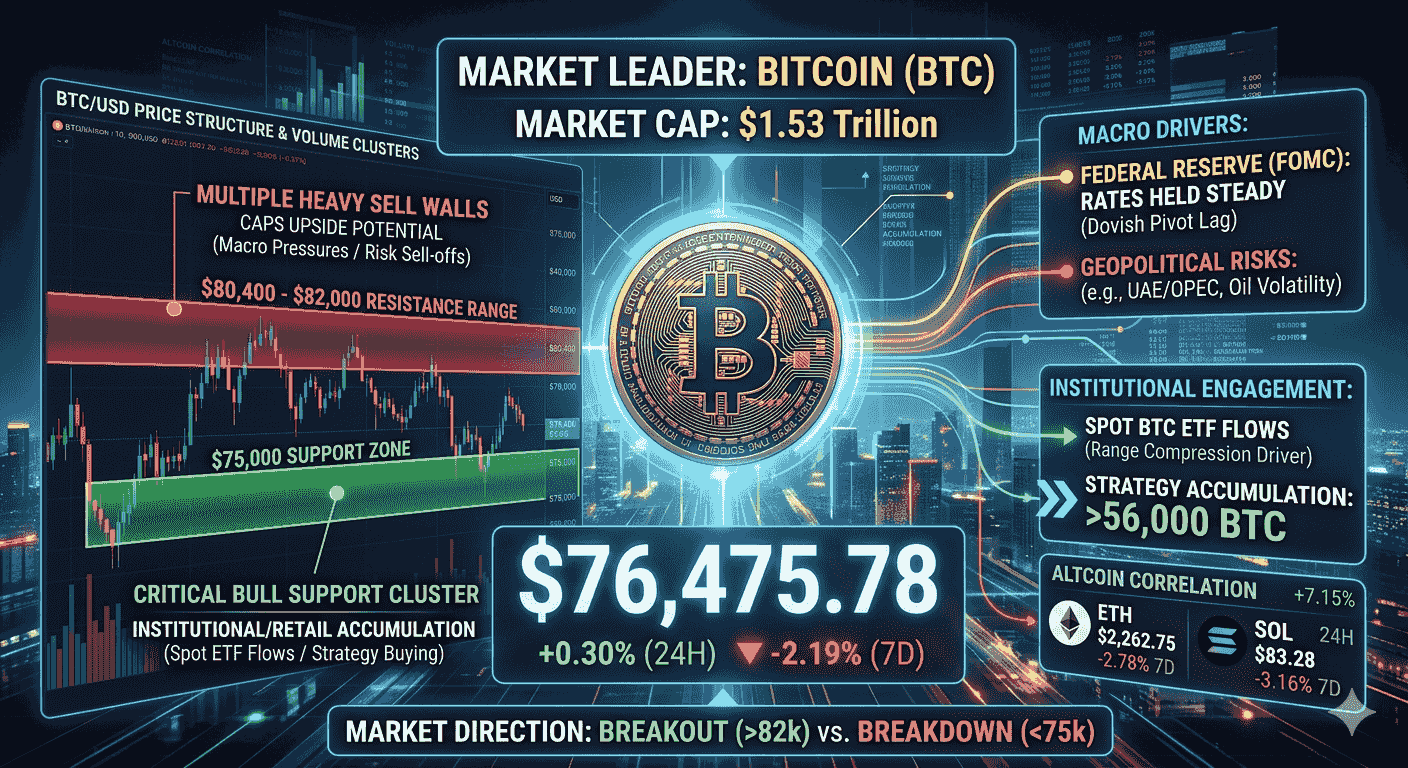
Bitcoin currently trades at approximately $76,475.78, reflecting a modest 24-hour gain of 0.30%. However, this short-term uptick follows a 7-day decline of -2.19%, indicating a period of consolidation after previous movements. With a commanding market capitalization of $1.53 trillion, Bitcoin maintains its position as the undisputed leader, representing a significant portion of the total global crypto market cap of $2.09 trillion.
Observed price action indicates a key support zone emerging around the $75,000 cost basis. This level is identified as a critical cluster for current bull trend support, suggesting institutional and retail accumulation in this range. Conversely, significant resistance is noted between $80,400 and $82,000, characterized by multiple substantial sell walls. This technical setup suggests Bitcoin is currently operating within a defined range, with these levels acting as pivotal points for short-term price direction. The compression of BTC's price range, influenced by spot ETF flows and spot positioning, appears to be laying the groundwork for a potential trending move, though the direction remains to be seen.
Why Bitcoin Is Driving The Tape
Several interconnected catalysts are influencing Bitcoin's current market behavior, largely stemming from macroeconomic conditions, institutional activity, and regulatory developments.
A primary driver for Bitcoin, and indeed the broader crypto market, has been the recent Federal Reserve Open Market Committee (FOMC) meeting. The Fed's decision to hold interest rates steady for the third consecutive time, as anticipated, has created a "mixed" sentiment in the market. While a pause in rate hikes can be seen as positive for risk assets, the lack of an immediate dovish pivot means that higher real rates continue to exert pressure on Bitcoin, capping its upside potential. This macroeconomic context is a significant factor contributing to the observed sell walls and range-bound trading.
Institutional engagement continues to shape Bitcoin's price structure. The emergence of the $75,000 cost basis as a strong support zone is directly linked to institutional buying behavior, particularly in the context of spot BTC ETF flows. These flows, alongside broader institutional positioning, are compressing Bitcoin's trading range, indicating a battle between buyers and sellers around these key levels. Furthermore, reports highlight that entities such as Strategy have continued to accumulate Bitcoin, stacking over 56,000 BTC, which reinforces the long-term institutional conviction despite short-term price fluctuations.
Macroeconomic narratives are also playing a role. A recent report from Bitso indicates a shift in purchasing behavior in Latin America, where stablecoins have begun to surpass Bitcoin in crypto purchases for everyday financial use. While this highlights the growing utility of stablecoins in inflation-hit economies, it also suggests a potential re-evaluation of Bitcoin's role as a primary transactional currency in certain regions, shifting focus towards its store-of-value proposition. Additionally, broader global economic events, such as the UAE's potential OPEC exit and associated oil volatility, are cited as triggers for risk sell-offs, further influencing Bitcoin's price dynamics and contributing to the $82,000 sell wall.
Regulatory developments, particularly in the United States, also cast a shadow. The US CFTC's lawsuits against four states regarding the enforcement of state-level gambling laws on prediction markets underscore the ongoing regulatory uncertainty within the broader crypto ecosystem. While not directly targeting Bitcoin, such actions contribute to a cautious institutional environment, which can indirectly affect capital flows into the leading cryptocurrency.
How The Rest Of The Market Is Responding
The broader cryptocurrency market is largely reflecting Bitcoin's lead, with mixed performance across major altcoins and some notable outliers in volatility. The overall sentiment for the selected editorial asset basket shows a mildly positive short-term bias, despite individual variations.
Ethereum (ETH), the second-largest cryptocurrency, has mirrored Bitcoin's recent trajectory, albeit with a slight lag. ETH registered a 24-hour decline of -0.29%, trading at approximately $2,262.75, and a 7-day loss of -2.78%. This performance suggests that Ethereum is consolidating alongside Bitcoin, with similar macro and institutional pressures influencing its price action.
Solana (SOL) also experienced a minor dip, down -0.61% over the past 24 hours to $83.28, and a -3.16% drop over the last seven days. Despite its price dip, Solana is actively expanding its institutional footprint, notably with the launch of a Swiss-based research institute aimed at helping European financial institutions evaluate its blockchain. This move underscores ongoing efforts to enhance regulatory clarity and on-chain usage, positioning Solana for potential future growth irrespective of immediate market movements.
Other major assets like XRP (-0.51% in 24h, -4.47% in 7d) and BNB (-0.60% in 24h, -3.60% in 7d) have also shown negative short-term performance, generally lagging Bitcoin's minimal 24-hour gain and confirming the broader negative trend over the past week. Dogecoin (DOGE) and TRON (TRX) showed slight positive 24-hour moves of 0.20% and 1.12% respectively, but their 7-day performances were divergent, with DOGE up significantly by 9.95% while TRX was down -0.37%.
In terms of volatility, Zcash (ZEC) stands out with a substantial 7.15% gain over the last 24 hours, currently trading at $350.14. WhiteBIT Coin (WBT) also saw a significant surge, up 5.60% in 24 hours to $57.31. These strong individual moves indicate specific asset-driven narratives or liquidity events not directly tied to the prevailing BTC-led macro themes. Conversely, Bitcoin Cash (BCH) experienced a notable decline, down -1.58% in 24 hours and -4.19% over seven days, highlighting negative volatility within the broader market.
The overall market picture is one where Bitcoin's consolidation phase, influenced by macro and institutional factors, sets a cautious tone. While some altcoins exhibit independent strength or weakness, the general trend among major assets appears to be one of correlation with Bitcoin's trajectory.
Conclusion and Risk Management
Bitcoin's current market posture is defined by a period of consolidation, anchored by a critical $75,000 support zone and encountering resistance near $82,000. This price structure is heavily influenced by a confluence of factors, including the Federal Reserve's steady interest rate policy, ongoing institutional capital flows into spot BTC ETFs, and broader macroeconomic considerations like global risk sentiment and shifts in stablecoin adoption.
The prevailing narrative suggests that Bitcoin is acting as the bellwether for the crypto market, with its price structure and the catalysts affecting it largely dictating the direction for other major assets. While the overall market for the selected asset basket shows a mildly positive short-term bias, this is nuanced by mixed individual performances and significant volatility in smaller-cap altcoins.
Looking ahead, the market's direction will likely hinge on Bitcoin's ability to either decisively break above the $82,000 resistance or find renewed support at the $75,000 level. Sustained institutional inflows and a clearer macroeconomic outlook, particularly regarding interest rate expectations, could provide the impetus for the next significant trend. Conversely, any sustained breakdown below key support levels could signal further downside pressure.
For market participants, effective risk management remains paramount. Given the current range-bound conditions for Bitcoin and the mixed performance across altcoins, a cautious approach is warranted. Monitoring Bitcoin's interaction with its established support and resistance levels, alongside developments in macroeconomics and regulation, will be crucial for navigating potential shifts. Diversification and understanding individual asset-specific catalysts, especially for highly volatile altcoins, are key considerations in managing exposure within this Bitcoin-led market environment. It is important to remember that past performance is not indicative of future results, and all investment decisions should be based on thorough research and an understanding of inherent market risks.
Source Data Reference
Market Snapshot Input
| Asset | Symbol | Price (USD) | 24h Change | Market Cap (USD) |
|---|---|---|---|---|
| Bitcoin | BTC | 76,475.778679 | 0.30% | 1,531,271,610,415 |
| Solana | SOL | 83.275155 | -0.61% | 47,973,829,813 |
| Ethereum | ETH | 2,262.74649 | -0.29% | 272,494,223,791 |
| Zcash | ZEC | 350.138245 | 7.15% | 5,717,151,447 |
| WhiteBIT Coin | WBT | 57.314946 | 5.60% | 8,260,144,967 |
| Dogecoin | DOGE | 0.106922 | 0.20% | 15,947,233,900 |
| XRP | XRP | 1.372353 | -0.51% | 84,654,665,940 |
| BNB | BNB | 615.929867 | -0.60% | 85,727,854,840 |
| Bitcoin Cash | BCH | 441.604134 | -1.58% | 8,772,813,660 |
| TRON | TRX | 0.32709 | 1.12% | 28,248,607,560 |
Trending Headlines Input
- Solana ecosystem expands institutional push with Europe-focused research arm
- Bitcoin, Ethereum Dip as Fed Holds Rates Steady for Third Straight Time
- Stablecoins overtake Bitcoin in Latin America crypto purchases — Bitso
- Bitcoin’s $75K cost basis emerges as key support zone for current bull trend
- US gov’t sues four states, RWAs cross $30 billion: Month in Charts
- Bitcoin's Upside Capped by $82K Sell Wall as UAE’s OPEC Exit Triggers Risk Sell-Off