Bitcoin Price Structure
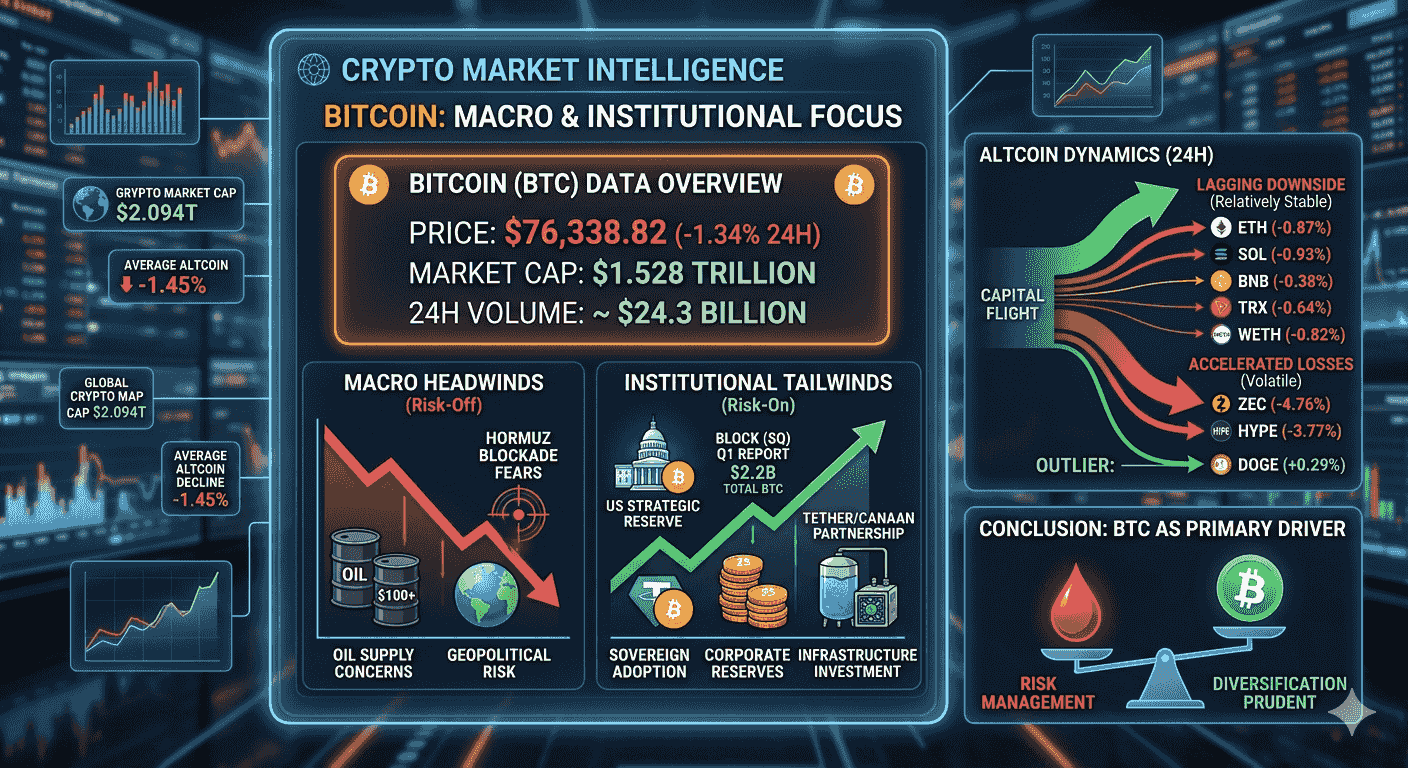
Bitcoin, the leading cryptocurrency by market capitalization, is currently trading at approximately $76,338.82. Over the past 24 hours, BTC has experienced a modest decline of -1.34%. This short-term dip contrasts with its largely stable performance over the last seven days, where it recorded a marginal gain of 0.02%. Bitcoin's market capitalization stands at a substantial $1.528 trillion, anchoring the total global crypto market cap of just over $2.094 trillion. Its 24-hour trading volume was reported at approximately $24.3 billion.
Observed data indicates that Bitcoin's recent 24-hour performance is slightly less pronounced than the average 24-hour decline across the broader market, which sits at -1.45%. This suggests that while BTC is participating in the current downturn, it is not leading the deepest losses. Its relative stability over the weekly timeframe further highlights its foundational position, absorbing short-term volatility without a significant directional shift over the longer period. This positioning implies that any sustained movement in Bitcoin's price is likely to have ripple effects across the entire digital asset ecosystem.
Why Bitcoin Is Driving The Tape
The current market environment sees Bitcoin's price action heavily influenced by a confluence of macroeconomic factors, institutional developments, and regulatory narratives. These elements collectively reinforce Bitcoin's position at the forefront of the market's direction.
A notable macroeconomic factor contributing to recent price adjustments is renewed concern over global oil supplies. Reports of $100 oil prices, coupled with fresh fears of an Asia crisis stemming from potential disruptions like the Strait of Hormuz blockade, have been cited as a catalyst for Bitcoin hitting a one-week low. This observation suggests that traditional global economic anxieties continue to impact risk assets, including Bitcoin, underscoring its increasing sensitivity to macro events.
Simultaneously, institutional and governmental signals continue to shape the narrative around Bitcoin. A White House crypto adviser recently hinted at a potential "breakthrough" regarding a U.S. Bitcoin strategic reserve. While details remain scarce and actual implementation faces hurdles from Treasury and a stalled Senate bill, the mere mention of such a move from a high-level government official can be interpreted as a significant long-term institutional endorsement. This kind of announcement has the potential to introduce a new layer of legitimacy and demand for Bitcoin from sovereign entities.
Further demonstrating institutional engagement, Jack Dorsey's Block disclosed its Q1 Proof-of-Reserves report, revealing substantial Bitcoin holdings. The fintech company reported $1.5 billion in customer Bitcoin and an additional $692 million in corporate treasury holdings, totaling $2.2 billion. This transparency from a major public company reinforces the trend of corporate adoption and the increasing integration of Bitcoin into traditional financial structures. Such disclosures provide a tangible measure of institutional confidence and demand for the asset.
On the regulatory front, while mixed in sentiment, developments also highlight Bitcoin's growing prominence. A Saipan woman was sentenced to 71 months in prison for a Bitcoin investment fraud scheme targeting elderly victims. This event, while negative in nature, underscores the ongoing efforts by federal prosecutors to address illicit activities within the crypto space, implicitly acknowledging Bitcoin's significant value and widespread adoption. Separately, stablecoin giant Tether announced a deepened partnership with Canaan to develop immersion-cooled mining systems and revealed plans for modular Bitcoin mining hardware. These developments in the mining sector indicate continued investment in Bitcoin's underlying infrastructure, suggesting a robust and evolving ecosystem, even if their direct market impact is more nuanced than institutional adoption or macro shifts.
Collectively, these factors — from macro-economic jitters directly impacting price to significant institutional and governmental interest, alongside ongoing infrastructure development and regulatory oversight — paint a picture of Bitcoin as an asset whose movements are deeply tied to a broad spectrum of external forces, thereby setting the overall market tone.
How The Rest Of The Market Is Responding
The broader cryptocurrency market is largely reflecting Bitcoin's lead, exhibiting a mildly negative short-term bias. While Bitcoin experienced a -1.34% decline over 24 hours, the reactions across major altcoins and more volatile assets show varying degrees of correlation and independent movement.
Among the top volatile assets, Zcash (ZEC) recorded the most significant 24-hour decline, dropping by -4.76%. Hyperliquid (HYPE) followed, with a -3.77% decrease. These pronounced movements suggest that certain altcoins are experiencing heightened selling pressure beyond what Bitcoin is currently facing, potentially due to asset-specific dynamics or lower liquidity.
Looking at other priority assets and major cryptocurrencies:
- XRP mirrored Bitcoin's movement closely, registering a -1.32% change over 24 hours.
- Ethereum (ETH), the second-largest cryptocurrency, saw a -0.87% decline, a smaller percentage loss than Bitcoin. Its wrapped counterpart, WETH, also posted a -0.82% decrease.
- Binance Coin (BNB) experienced a relatively modest -0.38% dip.
- Solana (SOL) declined by -0.93%.
- TRON (TRX) was down -0.64%.
These figures indicate that while the overall market is indeed in a negative short-term trend, many major altcoins are demonstrating relative resilience, or at least a lagging downside, compared to Bitcoin's movement. Their percentage losses are generally smaller than BTC's, suggesting that capital might not be flowing out of these assets as aggressively as from some higher-volatility altcoins or even BTC itself.
An outlier in the current market is Dogecoin (DOGE), which posted a slight gain of +0.29% over the past 24 hours. This positive movement against the prevailing negative trend for most major assets highlights that idiosyncratic factors or specific asset narratives can still drive independent price action, even in a Bitcoin-led market.
In summary, the market's response is one of confirmation of a general negative bias, but with nuanced differentiation. While Bitcoin sets the overall direction, the magnitude of price changes varies, with some altcoins experiencing more significant downturns (ZEC, HYPE), others showing relative stability or lagging declines (ETH, BNB, SOL, TRX), and a few even managing to post gains (DOGE). This suggests that while Bitcoin is the central force, the market is not uniformly correlated in its reactions.
Conclusion and Risk Management
Bitcoin's current price structure and the surrounding news landscape firmly establish its role as the primary determinant of short-term market direction. The asset's modest 24-hour decline, alongside its relative stability over a seven-day period, suggests a market grappling with mixed signals. On one hand, macroeconomic pressures, exemplified by rising oil prices and global crisis fears, are observed to exert downward pressure on Bitcoin. On the other, significant institutional interest, as seen in Block's substantial Bitcoin holdings and the White House adviser's hints at a strategic reserve, provides a strong underlying narrative of growing adoption and potential future demand.
The broader market, while generally reflecting a mildly negative short-term bias, shows varied responses. While some altcoins like Zcash and Hyperliquid exhibit more pronounced declines, others such as Ethereum and BNB demonstrate slightly less negative movement than Bitcoin. This indicates that while Bitcoin's lead is undeniable, altcoin performance is not uniformly correlated, with some assets showing relative strength or lagging effects.
Looking ahead, market participants should consider the dual nature of current influences on Bitcoin. The potential for further macroeconomic headwinds could continue to test support levels. Conversely, any concrete advancements regarding governmental strategic reserves or increased institutional adoption could provide significant bullish impetus.
From a risk management perspective, the current environment necessitates careful consideration. The observed short-term negative bias across the market, combined with the concentration of stronger 24-hour moves in specific assets (ZEC, HYPE, BTC), underscores the inherent volatility. Investors may consider monitoring Bitcoin's price action closely, as its ability to navigate macroeconomic turbulence and capitalize on institutional tailwinds will likely dictate the broader market's trajectory. Diversification and a clear understanding of individual asset-specific drivers, particularly for altcoins displaying higher volatility or divergent performance, remain prudent strategies in this Bitcoin-led market.
Source Data Reference
Market Snapshot Input
| Asset | Symbol | Price (USD) | 24h Change | Market Cap (USD) |
|---|---|---|---|---|
| Bitcoin | BTC | 76,338.820135 | -1.34% | 1,528,465,399,104 |
| Zcash | ZEC | 336.32907 | -4.76% | 5,491,671,534 |
| XRP | XRP | 1.380306 | -1.32% | 85,144,084,086 |
| Hyperliquid | HYPE | 40.034582 | -3.77% | 13,368,675,039 |
| Solana | SOL | 84.023594 | -0.93% | 48,395,046,375 |
| Dogecoin | DOGE | 0.099473 | 0.29% | 14,836,129,664 |
| TRON | TRX | 0.32311 | -0.64% | 27,904,857,640 |
| BNB | BNB | 624.962064 | -0.38% | 86,984,996,134 |
| WETH | WETH | 2,288.777953 | -0.82% | 8,619,299,736 |
| Ethereum | ETH | 2,288.525009 | -0.87% | 275,598,635,960 |
Trending Headlines Input
- Woman Gets 71 Months in Prison Over Bitcoin Investment Fraud Targeting Elderly Victims
- White House Crypto Adviser Hints at ‘Breakthrough’ Bitcoin Reserve Move
- Jack Dorsey's Block Discloses $2.2B Bitcoin Holdings in Q1 Proof-of-Reserves Report
- Canaan, Tether deepen partnership on immersion-cooled mining systems
- Bitcoin price hits one-week low as $100 oil sparks fresh Asia crisis fears
- Stablecoin Giant Tether Reveals Plans for Modular Bitcoin Mining Hardware