Bitcoin Price Structure
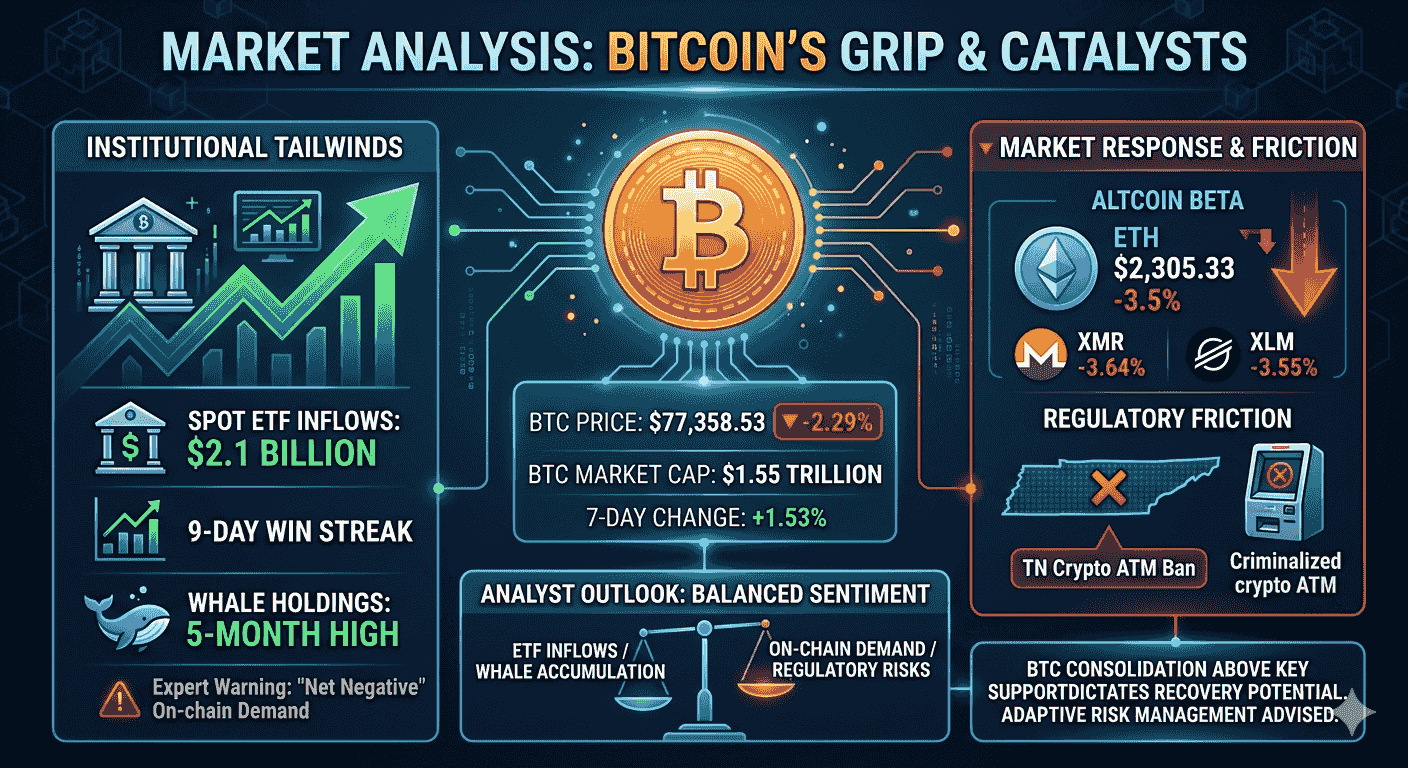
Bitcoin is currently trading at approximately $77,358.53, registering a 24-hour price change of -2.29%. This movement comes amidst a global crypto market capitalization of $2.09 trillion, where Bitcoin maintains a substantial influence as the largest digital asset by market capitalization, currently standing at $1.55 trillion. Despite the recent daily dip, Bitcoin has shown resilience over the past seven days, recording a positive change of 1.53%.
Observed data indicates that Bitcoin's 24-hour decline is less pronounced than the average 24-hour move across the broader market, which sits at approximately -2.91%. This suggests a degree of relative strength in BTC compared to many other digital assets during this period. The asset's significant market share and comparatively muted daily negative movement position it as the bellwether for current market sentiment and direction.
Why Bitcoin Is Driving The Tape
Bitcoin's market leadership is not merely a function of its size but is actively shaped by specific, high-impact catalysts. Recent news signals point to a blend of institutional engagement and evolving regulatory pressures that are directly influencing BTC's price action and broader market tone.
A notable development is the continued inflow into spot Bitcoin Exchange-Traded Funds (ETFs). These ETFs have extended their longest win streak since September, attracting $2.1 billion in inflows over nine consecutive days. This sustained institutional demand is a significant factor, indicating a persistent appetite for Bitcoin exposure from traditional finance. However, it is important to contextualize this with expert warnings of "net negative" on-chain demand, suggesting that while capital flows into ETFs, underlying organic demand on the blockchain may not be keeping pace. This creates a mixed sentiment, where institutional interest provides a floor, but broader market participation needs to strengthen for sustained upward momentum.
Further reinforcing the institutional narrative, Bitcoin whale holdings have reportedly hit a five-month high. This accumulation by large holders and institutional investors is interpreted by some analysts as potentially reducing the available supply of BTC, which could set the stage for future price appreciation. The thesis here is that increased holding by significant entities can constrict supply, thereby creating upward pressure on price, potentially targeting levels above $80,000. This observed behavior highlights a strategic positioning by major players who appear to be accumulating during periods of consolidation or minor pullbacks.
On the regulatory front, there have been developments that introduce a degree of caution. Tennessee has become the second U.S. state to outlaw Bitcoin and crypto ATMs, making their ownership or operation a criminal offense. While this is a localized regulatory action, it represents a broader trend of increasing scrutiny and varied approaches to cryptocurrency regulation across different jurisdictions. Such measures, even if geographically limited, can contribute to uncertainty regarding the ease of access and adoption of Bitcoin for retail users, potentially dampening sentiment in specific regions.
Collectively, these factors—robust institutional ETF inflows despite mixed on-chain demand, strategic whale accumulation, and evolving regulatory environments—create a complex backdrop that sees Bitcoin at the forefront of market dynamics. The institutional interest provides a strong undercurrent of support, while regulatory actions introduce headwinds that necessitate careful monitoring.
How The Rest Of The Market Is Responding
The broader cryptocurrency market is largely reacting to Bitcoin's lead, exhibiting a mildly negative short-term bias. The average 24-hour move across the market, as noted, is more negative than Bitcoin's, indicating that altcoins are generally experiencing more significant pullbacks.
Ethereum (ETH), the second-largest cryptocurrency by market cap, is currently trading around $2,305.33, reflecting a 24-hour decline of 3.5% and a 7-day decline of 0.80%. This performance indicates that Ethereum is underperforming Bitcoin in the immediate 24-hour window, confirming the BTC-led downturn. While there are specific institutional activities around ETH, such as BitMine acquiring 101,000 ETH despite unrealized losses, and Aave requesting Arbitrum to unfreeze 30K ETH, these appear to be idiosyncratic to Ethereum and are not currently overriding the broader market's response to Bitcoin's price structure.
Beyond the majors, the strongest 24-hour moves are concentrated in several assets, predominantly to the downside. Monero (XMR) has seen a 3.64% decline, while Stellar (XLM) is down 3.55%, and WETH (WETH) has also fallen by 3.55%. These assets, identified among the top volatile assets, are experiencing more pronounced negative shifts than Bitcoin, suggesting that capital is either flowing out of these riskier assets or their liquidity is thinner, leading to larger percentage drops in response to overall market weakness. This overall trend reinforces the observation that when Bitcoin experiences a downturn, altcoins often follow with amplified movements, reflecting a higher risk appetite in those segments of the market. The general market sentiment, as derived from current asset performance, leans towards a mildly negative short-term bias across the selected asset basket.
Conclusion and Risk Management
Bitcoin's current price structure and the surrounding catalysts firmly establish its role as the primary driver of market direction. The interplay between sustained institutional interest, evidenced by Bitcoin ETF inflows and whale accumulation, and emerging regulatory hurdles, such as the ban on crypto ATMs in Tennessee, creates a nuanced environment. While institutional capital provides a structural tailwind, the "net negative" on-chain demand and regulatory actions introduce elements of caution.
The broader market, including Ethereum and other altcoins, largely mirrors Bitcoin's movements, often with greater volatility. The observed mildly negative short-term bias across the market suggests that participants are adjusting positions in response to Bitcoin's lead.
For market participants, understanding these Bitcoin-centric dynamics is crucial. The current environment suggests that Bitcoin's ability to consolidate above key support levels, or its reaction to further institutional news or regulatory clarity, will likely dictate the next phase for the entire crypto ecosystem. Risk management strategies should acknowledge the prevailing mildly negative short-term bias and the potential for amplified movements in altcoins if Bitcoin's trajectory becomes more definitively bearish. Conversely, a strong recovery in Bitcoin, particularly driven by confirmed institutional demand and favorable regulatory signals, could provide a foundation for broader market recovery. However, given the mixed signals, a balanced and adaptive approach to market exposure is advisable.
Source Data Reference
Market Snapshot Input
| Asset | Symbol | Price (USD) | 24h Change | Market Cap (USD) |
|---|---|---|---|---|
| Bitcoin | BTC | 77,358.525822 | -2.29% | 1,548,848,732,300 |
| Ethereum | ETH | 2,305.328887 | -3.50% | 277,622,265,081 |
| Zcash | ZEC | 353.545611 | -2.42% | 5,772,787,845 |
| Monero | XMR | 378.800981 | -3.64% | 6,987,644,727 |
| XRP | XRP | 1.399275 | -2.86% | 86,314,200,529 |
| Solana | SOL | 84.787925 | -3.09% | 48,835,340,599 |
| Stellar | XLM | 0.165999 | -3.55% | 5,526,798,897 |
| WETH | WETH | 2,304.250403 | -3.55% | 8,677,567,376 |
| BNB | BNB | 626.874393 | -1.86% | 87,251,162,608 |
| Hyperliquid | HYPE | 41.714105 | -2.32% | 13,929,515,262 |
Trending Headlines Input
- Bitcoin ETFs Extend Longest Win Streak Since September, But Spot Demand Lags
- Bitcoin whale holdings hit five-month high: Is BTC headed to $80K next?
- BitMine acquires 101,000 ETH despite $6.5B in unrealized losses
- Aave asks Arbitrum to send 30K ETH from Kelp exploiter to ‘DeFi United’
- Tennessee Becomes Second State to Outlaw Bitcoin, Crypto ATMs
- Tom Lee's BitMine Buys Another $23 Million in ETH From Ethereum Foundation


