Bitcoin Price Structure
Bitcoin is presently trading at approximately $77,578.57, reflecting a marginal 24-hour increase of 0.11%. This modest upward movement contrasts with the broader crypto market's average 24-hour change of approximately -0.40%, signaling Bitcoin's relative strength and resilience. Over the past seven days, BTC has registered a more substantial gain of 2.51%, indicating sustained positive momentum on a weekly timeframe.
With a commanding market capitalization of approximately $1.553 trillion, Bitcoin remains the undisputed leader, accounting for a substantial portion of the total global crypto market cap of $2.104 trillion. This dominance highlights Bitcoin's benchmark status, where its price action often serves as a bellwether for the rest of the digital asset ecosystem. The 24-hour trading volume for BTC stands at around $13.126 billion, reflecting consistent investor interest and liquidity at current price levels.
Observed facts indicate that Bitcoin is holding its ground, even registering a slight positive movement, in an environment where the average asset is seeing a minor pullback. This positioning suggests a degree of decoupling from general market weakness, reinforcing its role as a primary indicator of market health and direction.
Why Bitcoin Is Driving The Tape
Bitcoin's current market behavior is significantly influenced by a confluence of institutional developments, macro-economic considerations, and ongoing regulatory dialogue. These factors collectively contribute to Bitcoin's narrative as the leading asset, shaping market expectations and capital flows.
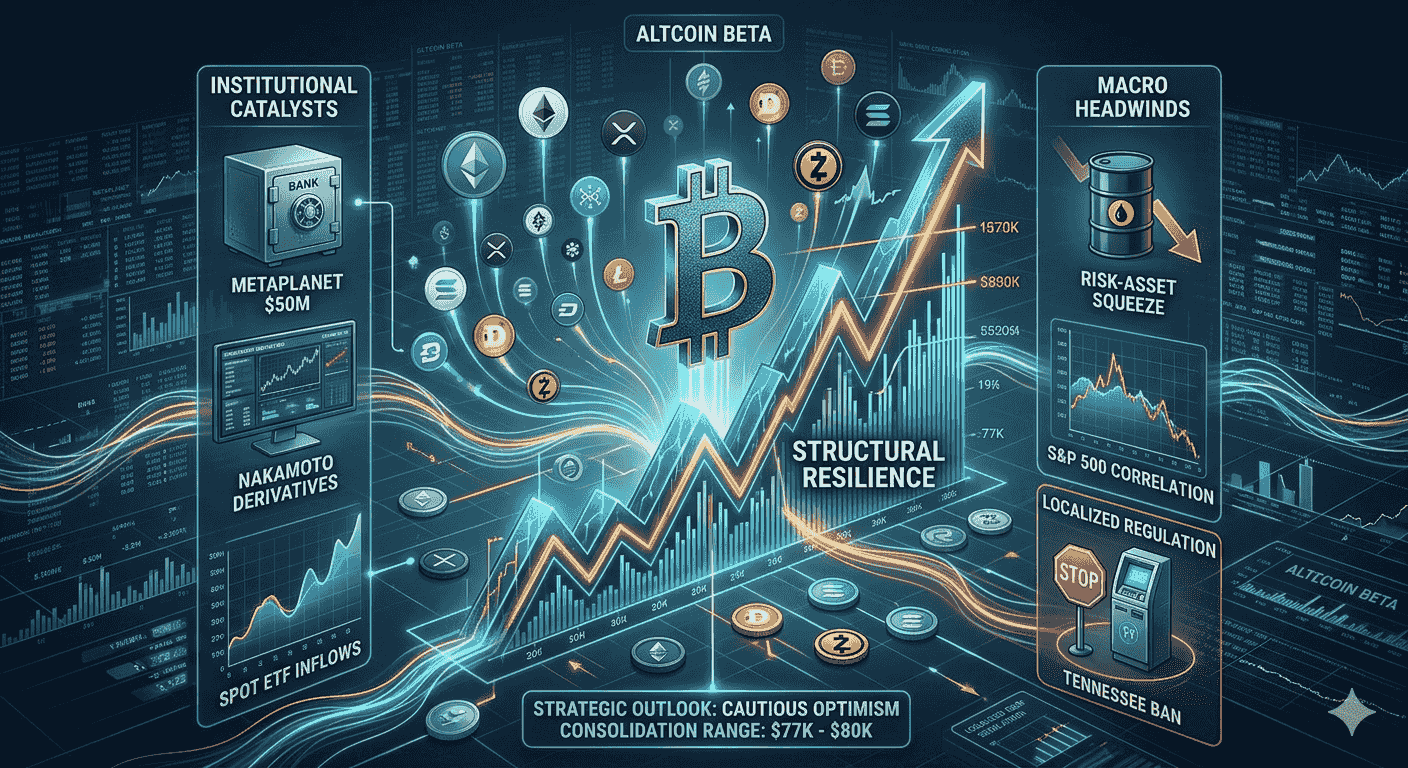
A notable catalyst is the continued institutional interest in Bitcoin. Metaplanet, a Japanese firm, recently announced a successful raise of $50 million through zero-interest bonds, explicitly stating its intention to acquire more Bitcoin for its treasury. This move echoes strategies employed by other publicly traded companies, demonstrating a growing trend of corporate Bitcoin accumulation as a treasury reserve asset. Such institutional adoption provides a robust demand floor and signals long-term confidence in Bitcoin's value proposition.
Further reinforcing this institutional perspective, analysts from VanEck, a prominent ETF provider, have pointed to a recovery in Bitcoin's hash rate and negative funding rates as potential indicators for future gains. This analysis, coming from a traditional finance entity deeply involved in the Bitcoin spot ETF market, can influence investor sentiment and reinforce a bullish outlook for the asset. The fact that Bitcoin recently hit its highest price since January is also cited by these analysts as a sign of underlying strength.
On the regulatory front, Bitcoin remains a topic of discussion at high levels. Recent commentary from Bitcoin advocates questioning the U.S. military's understanding of the network, as reported in Senate testimony, highlights the ongoing, albeit sometimes misinformed, engagement of governmental bodies with Bitcoin. While not directly impacting price, such discussions underscore Bitcoin's growing geopolitical relevance and the continuous process of regulatory bodies attempting to comprehend and potentially integrate digital assets.
However, the market is not without its macro-economic considerations. Reports suggest that Bitcoin's price has remained "stalled" around the $78,000 mark, with concerns that rising oil prices could threaten a new "risk-asset squeeze." This interpretation connects Bitcoin's performance to broader global economic indicators, suggesting that while institutional adoption provides tailwinds, macro pressures can introduce headwinds, potentially capping upward movements or increasing volatility. This interplay between strong fundamental demand and external economic forces is a key dynamic influencing Bitcoin's current market behavior.
How The Rest Of The Market Is Responding
While Bitcoin demonstrates relative stability, the broader cryptocurrency market is exhibiting a more varied response, largely reflecting the prevailing mildly negative short-term bias identified across the selected editorial asset basket. Many altcoins are either consolidating or experiencing minor pullbacks, indicating that Bitcoin's lead is not uniformly translating into a widespread market rally.
Ethereum (ETH), the second-largest cryptocurrency by market capitalization, has shown a marginal 24-hour gain of 0.02%, trading around $2,318.27. However, its 7-day performance shows a decline of 1.18%, lagging behind Bitcoin's weekly strength. This suggests that while ETH is not experiencing significant losses in the short term, it is not confirming Bitcoin's upward momentum on a weekly basis.
XRP, another priority asset, is currently trading at approximately $1.42, having declined by 0.74% over the past 24 hours and 0.81% over the last seven days. News analysis directly contrasts XRP's performance against Bitcoin, noting that XRP's price risks a significant decline versus Bitcoin, despite a nine-day streak of spot XRP ETF inflows. This observation explicitly positions Bitcoin as the stronger asset against XRP, reinforcing the narrative of BTC's leadership.
Looking at the broader market, the strongest 24-hour moves are concentrated in specific, often more volatile, assets. MemeCore (M), for instance, has seen a 24-hour decline of 3.33%, despite a substantial 25.31% gain over the last seven days, indicating sharp intraday volatility. Binance Coin (BNB) also registered a 24-hour decrease of 1.18%. In contrast, Hyperliquid (HYPE) recorded a 24-hour gain of 0.94%, though it is down 4.93% over seven days.
Other notable assets show mixed signals:
- Zcash (ZEC) posted a 0.11% 24-hour gain and a strong 10.32% increase over seven days, suggesting some independent strength.
- Monero (XMR) saw a 0.67% 24-hour gain and a 5.99% 7-day increase, outperforming Bitcoin in the short term.
- Dogecoin (DOGE) is down 0.49% over 24 hours, while Solana (SOL) experienced a minor 0.09% decline.
Overall, the data suggests a market where Bitcoin is exhibiting relative stability and modest positive performance, while many altcoins, including some major ones, are either underperforming or experiencing greater volatility. The market's response is largely reactive to Bitcoin's lead, with only a few select altcoins showing independent strength or significant divergence.
Conclusion and Risk Management
Bitcoin currently stands as the primary driver of market sentiment and direction, demonstrating notable resilience and positive weekly performance even as the broader market experiences a mildly negative short-term bias. The thesis that Bitcoin is setting the tone for current crypto market direction, with the broader market reacting around it, appears to be well-supported by observed price action and news signals.
Key catalysts for Bitcoin's sustained lead include ongoing institutional accumulation, exemplified by firms like Metaplanet expanding their BTC treasuries, and positive analytical outlooks from traditional finance entities such as VanEck. These factors contribute to a robust demand narrative for Bitcoin. However, the market is not without its complexities. Bitcoin's price has been observed to be "stalled" around the $78,000 level, and broader macro-economic concerns, such as the potential for rising oil prices to trigger a risk-asset squeeze, introduce elements of uncertainty.
For risk management, market participants might consider Bitcoin's current structure as a central barometer. While Bitcoin shows relative stability, the derived insight of a "mildly negative short-term bias" across the broader market, coupled with concentrated volatility in assets like MemeCore, BNB, and Hyperliquid, indicates that altcoins carry higher individual risk profiles. The divergent performance among altcoins suggests that capital is not uniformly flowing into the broader market following Bitcoin's lead; instead, it appears more selective or cautious.
Looking forward, monitoring the interplay between sustained institutional demand for Bitcoin and evolving macro-economic conditions will be crucial. Any significant shift in these fundamental drivers could impact Bitcoin's ability to maintain its current price structure and, by extension, influence the direction of the entire crypto market. For altcoins, their performance will likely remain highly dependent on Bitcoin's trajectory, with specific narratives or fundamental developments required to generate significant, sustained outperformance. Investors should remain aware of the distinct risk profiles across different asset classes within the crypto ecosystem, particularly given the observed divergence in performance against Bitcoin.
Source Data Reference
Market Snapshot Input
| Asset | Symbol | Price (USD) | 24h Change | Market Cap (USD) |
|---|---|---|---|---|
| Bitcoin | BTC | 77,578.573256 | 0.11% | 1,553,185,099,435 |
| XRP | XRP | 1.423645 | -0.74% | 87,817,430,704 |
| Ethereum | ETH | 2,318.272227 | 0.02% | 279,180,983,830 |
| MemeCore | M | 4.336771 | -3.33% | 5,613,254,194 |
| Zcash | ZEC | 357.922838 | 0.11% | 5,844,260,373 |
| BNB | BNB | 628.689214 | -1.18% | 87,503,757,507 |
| Monero | XMR | 371.708064 | 0.67% | 6,856,803,501 |
| Hyperliquid | HYPE | 41.497751 | 0.94% | 13,857,268,430 |
| Dogecoin | DOGE | 0.097989 | -0.49% | 14,614,792,387 |
| Solana | SOL | 86.16573 | -0.09% | 49,618,651,768 |
Trending Headlines Input
- XRP price risks 40% decline versus Bitcoin despite 9-day ETF inflow streak
- Metaplanet raises $50M in zero-interest bonds to buy more Bitcoin
- Bitcoiners cast doubt on the US military's understanding of the network
- Bitcoin Hit Its Highest Price Since January—Why VanEck Analysts See More Potential Gains
- Bitcoin stays 'stalled' at $78K as oil threatens new risk-asset squeeze
- Aave Leads ‘DeFi United’ Push to Contain $292M KelpDAO Fallout