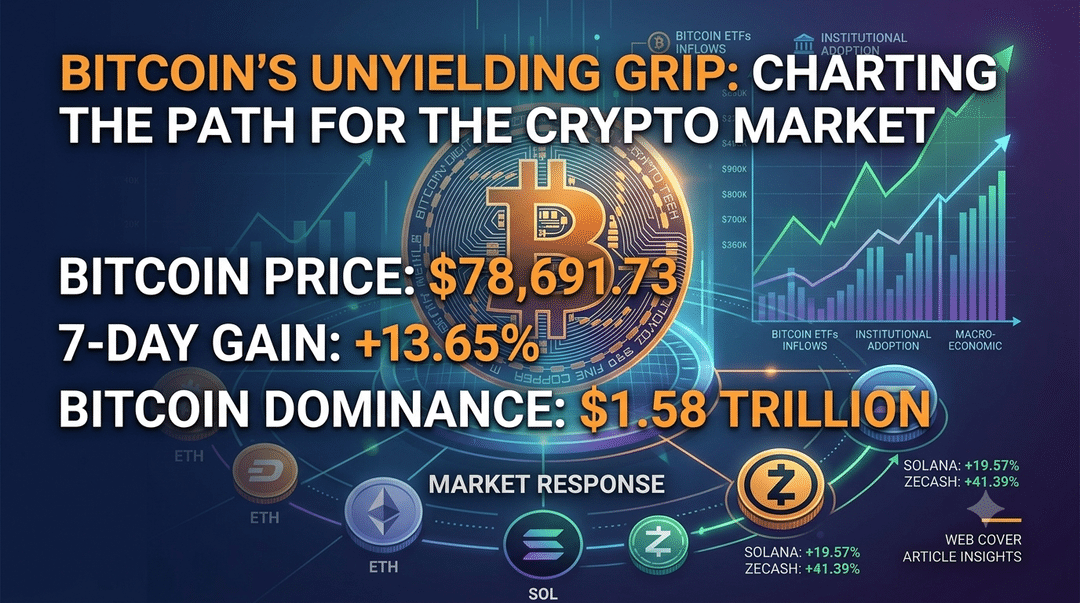
Global Market Capitalization
The broader cryptocurrency market currently reflects a landscape shaped by a mix of upward momentum in key assets and an overall mildly positive short-term bias, as indicated by recent performance metrics. The total global cryptocurrency market capitalization stands at approximately $2.167 trillion. Across the top assets, the average 24-hour price movement observed is an increase of approximately 1.21%. This suggests a general, albeit moderate, upward trend across the leading digital assets.
Bitcoin (BTC), the largest cryptocurrency by market capitalization, has demonstrated notable strength, recording a price of $78,165.67 with a 24-hour increase of 2.38%. Its market capitalization is approximately $1.565 trillion, underscoring its dominant position in the ecosystem. This upward movement in Bitcoin often serves as a bellwether for the wider market, with its performance frequently influencing investor sentiment across other digital assets.
Ethereum (ETH), the second-largest asset, also experienced positive movement, trading at $2,367.65 after a 1.82% gain over the past 24 hours. Its market capitalization is approximately $285.13 billion. The performance of Ethereum, particularly given its central role in decentralized finance (DeFi) and smart contract platforms, is often a key indicator of health within these interconnected sectors.
Among other significant large-cap assets, Binance Coin (BNB) showed a more modest gain of 0.84%, reaching a price of $637.92, with a market cap of approximately $88.79 billion. Solana (SOL) also posted a positive, though small, 24-hour change of 0.47%, priced at $86.75 and holding a market cap of approximately $49.93 billion. These movements suggest a degree of sustained interest in platforms supporting various decentralized applications.
Conversely, some assets within the top market capitalization bracket exhibited slight declines. XRP registered a marginal decrease of 0.23%, trading at $1.43, with a market cap of approximately $87.85 billion. TRON (TRX) also saw a decline of 1.02%, priced at $0.33, with a market cap of approximately $28.45 billion. These mixed movements among the top assets highlight an uneven distribution of short-term price action, even within a generally positive market context.
Lido Staked Ether (STETH) and Wrapped Liquid Staked Ether 2.0 (WSTETH), both derivatives tied to Ethereum staking, posted gains of 1.91% and 2.09% respectively. STETH was priced at $2,361.08 with a market cap of $23.13 billion, while WSTETH was at $2,912.94 with a market cap of $10.36 billion. Their performance generally mirrors that of Ethereum, reflecting ongoing activity and interest in liquid staking solutions. Dogecoin (DOGE) also saw a 0.91% increase, trading at $0.096 with a market cap of $14.32 billion. Hyperliquid (HYPE) experienced a significant 2.89% increase, reaching $41.08 with a market cap of $13.72 billion. The collective performance of these large-cap assets indicates that while the overall market shows a mildly positive short-term bias, individual asset performance can vary considerably.
Top 3 Most Volatile Coins
In the last 24 hours, specific assets within the broader market have demonstrated higher levels of volatility, indicating concentrated trading activity or significant shifts in short-term market perception. Examining these assets can offer insights into areas of intensified focus or developing narratives within the crypto space.
The asset with the strongest positive 24-hour price movement among the tracked top assets is Hyperliquid (HYPE). HYPE recorded a substantial increase of 2.89%, reaching a price of $41.08. With a market capitalization of approximately $13.72 billion, HYPE's pronounced upward movement suggests a strong short-term bullish sentiment or specific catalysts driving its performance. Such movements in assets with significant market caps can attract increased attention from traders seeking momentum.
Following Hyperliquid, Bitcoin (BTC) stands out as the second most volatile asset within this group, posting a 24-hour gain of 2.38%. Trading at $78,165.67, Bitcoin's volatility, even with its massive market capitalization of $1.565 trillion, is noteworthy. As the market leader, Bitcoin's significant price swings often have a broader impact, potentially influencing the direction of other digital assets and overall market sentiment. Its movement can be seen as a bellwether for market conviction.
Wrapped Liquid Staked Ether 2.0 (WSTETH) is the third asset to exhibit considerable volatility, with a 24-hour increase of 2.09%. WSTETH is priced at $2,912.94 and holds a market capitalization of approximately $10.36 billion. As a derivative of staked Ethereum, its volatility is often closely linked to the performance of Ethereum itself and the ongoing interest in liquid staking protocols. Its strong performance suggests continued confidence in the Ethereum ecosystem and the utility of staked assets.
The heightened volatility observed in these assets—HYPE, BTC, and WSTETH—can be interpreted in several ways. For HYPE, it might point to a specific project-driven catalyst or increased speculative interest. For Bitcoin, its volatility often reflects macroeconomic factors, institutional flows, or significant market events. In the case of WSTETH, it likely underscores the ongoing demand and utility within the Ethereum staking landscape. These stronger short-term movers often drive narrative focus and can indicate areas where market participants are actively seeking or reacting to opportunities.
Trending News and Market Impact
Recent headlines provide crucial context for understanding the current market backdrop, reflecting a mix of institutional engagement, regulatory discussions, and market analysis. These news signals contribute to the overall sentiment and can influence price action, particularly for large-cap assets.
One significant development is the launch of an actively managed Bitcoin, Ethereum, and Solana basket ETF on Nasdaq by crypto market maker GSR. This news, categorized under "institutional," highlights a growing trend of traditional financial institutions offering regulated investment vehicles for cryptocurrencies. The inclusion of BTC, ETH, and SOL in such an ETF could potentially increase accessibility for institutional investors, thereby contributing to demand and market liquidity for these assets. This move suggests a continued maturation of the crypto market and its integration into traditional finance, which is generally perceived as a positive long-term signal for the market.
Further institutional interest in Bitcoin is underscored by the report that Michael Saylor's firm now holds $62 billion in Bitcoin. This news, while not new in its core subject, reinforces the narrative of substantial corporate accumulation of BTC. Such large-scale, long-term holdings by public companies can be interpreted as a strong vote of confidence in Bitcoin's value proposition and scarcity, potentially influencing investor psychology and contributing to Bitcoin's price stability or upward trajectory.
On the regulatory front, a notable headline indicates that the US government runs a Bitcoin node, with a US Admiral stating the military is investigating Bitcoin’s ability to "secure and protect networks." This revelation, falling under "regulation," could be interpreted as a mixed signal. While it demonstrates government engagement and recognition of Bitcoin's underlying technology, the context of military investigation might also raise questions about potential future regulatory stances or applications. It highlights a complex and evolving relationship between state actors and decentralized technologies. Separately, Coinbase's decision to shift its New York prediction markets fight to federal court signals ongoing legal and regulatory battles within the crypto industry. This specific legal challenge, while not directly impacting major asset prices in the short term, underscores the persistent regulatory uncertainty and the industry's efforts to clarify legal frameworks, which can affect broader market sentiment over time.
Market analysis also provides valuable insights. A report suggesting Ethereum risks a 10% decline versus Bitcoin, despite record ETH staking, offers a nuanced perspective. While record staking (32.33% of ETH supply) implies reduced liquid supply and potential long-term price support by reducing sell pressure, the analysis points to a potential short-term underperformance relative to Bitcoin. This highlights the ongoing "flippening" debate and the dynamic relationship between the two largest cryptocurrencies, with market participants constantly assessing their relative strengths.
Finally, news that Bitcoin is chasing a monthly high above $80K, with nearly all BTC price metrics turning bullish, suggests strong technical and on-chain indicators supporting its recent rally. This positive market structure analysis, combined with the observed price action, indicates a robust short-term outlook for Bitcoin, although it also cautions about potential profit-taking in higher price ranges ($83,000 to $88,000). Such analyses often guide short-term trading decisions and contribute to momentum-driven movements.
Collectively, these headlines paint a picture of a market grappling with increasing institutional adoption and regulatory scrutiny, while core assets like Bitcoin and Ethereum demonstrate varied but generally positive price action, supported by fundamental developments and technical indicators.
Conclusion and Risk Management
The cryptocurrency market is currently navigating a dynamic environment characterized by a blend of headline-driven catalysts and varied short-term price movements across large-cap assets. Our analysis indicates that the top market-cap basket exhibits a mildly positive short-term bias, largely influenced by the upward trajectory of key assets like Bitcoin and Ethereum.
As highlighted by our derived insights, the strongest 24-hour moves have been concentrated in Hyperliquid (HYPE), Bitcoin (BTC), and Wrapped Liquid Staked Ether 2.0 (WSTETH). These assets have demonstrated notable volatility, potentially reflecting areas of heightened market interest or specific catalysts impacting their respective ecosystems. Bitcoin's substantial gain, even with its massive market capitalization, underscores its continued role as a primary driver of market sentiment.
The available news signals, numbering six recent headlines, provide crucial context for these market movements. Institutional developments, such as GSR's actively managed Bitcoin, Ethereum, and Solana ETF launch on Nasdaq, signal increasing traditional finance integration and potential for broader adoption. Reports of the US government running a Bitcoin node and Michael Saylor's firm accumulating significant BTC holdings further illustrate the growing, albeit complex, engagement with digital assets by established entities. Simultaneously, market analyses pointing to Bitcoin's bullish metrics and Ethereum's relative performance against Bitcoin offer granular perspectives on asset-specific dynamics.
It is important to explicitly separate observed facts, such as specific price changes and market capitalization figures, from interpretations regarding market sentiment or potential future movements. While headlines can explain shifts in sentiment, conviction should remain measured, as the crypto market is inherently susceptible to rapid changes based on a multitude of factors, including macroeconomic shifts, regulatory developments, and technological advancements.
Given this complex backdrop, a measured approach to market participation is advisable. The inherent volatility of digital assets necessitates a robust risk management framework. This includes, but is not limited to, understanding the liquidity profiles of different assets, diversifying exposure where appropriate, and maintaining awareness of both macro and micro-level developments. The market's reaction to news, while sometimes immediate, can also be delayed or re-evaluated, underscoring the importance of continuous monitoring and a nuanced understanding of information. As always, market participants should conduct their own research and consider their individual risk tolerance.
Source Data Reference
Market Snapshot Input
| Asset | Symbol | Price (USD) | 24h Change | Market Cap (USD) |
|---|---|---|---|---|
| Bitcoin | BTC | 78,165.670117 | 2.38% | 1,564,838,336,404 |
| Ethereum | ETH | 2,367.652097 | 1.82% | 285,127,619,618 |
| BNB | BNB | 637.916319 | 0.84% | 88,788,026,966 |
| XRP | XRP | 1.426913 | -0.23% | 87,854,580,074 |
| Solana | SOL | 86.745638 | 0.47% | 49,931,927,725 |
| TRON | TRX | 0.329435 | -1.02% | 28,451,093,554 |
| Lido Staked Ether | STETH | 2,361.077344 | 1.91% | 23,125,333,578 |
| Dogecoin | DOGE | 0.096007 | 0.91% | 14,319,195,383 |
| Hyperliquid | HYPE | 41.083968 | 2.89% | 13,719,094,673 |
| Wrapped Liquid Staked Ether 2.0 | WSTETH | 2,912.938431 | 2.09% | 10,357,625,480 |
Trending Headlines Input
- GSR Launches Actively Managed Bitcoin, Ethereum and Solana Basket ETF on Nasdaq
- US Government Runs a Bitcoin Node, But Not Mining BTC: US Admiral
- Ethereum risks 10% decline versus Bitcoin despite record ETH staking
- Strategy Now Holds $62 Billion in Bitcoin—These Are Its Biggest BTC Buys
- Bitcoin chases monthly high above $80K as nearly all BTC price metrics turn bullish
- Coinbase shifts New York prediction markets fight to federal court