Global Market Capitalization
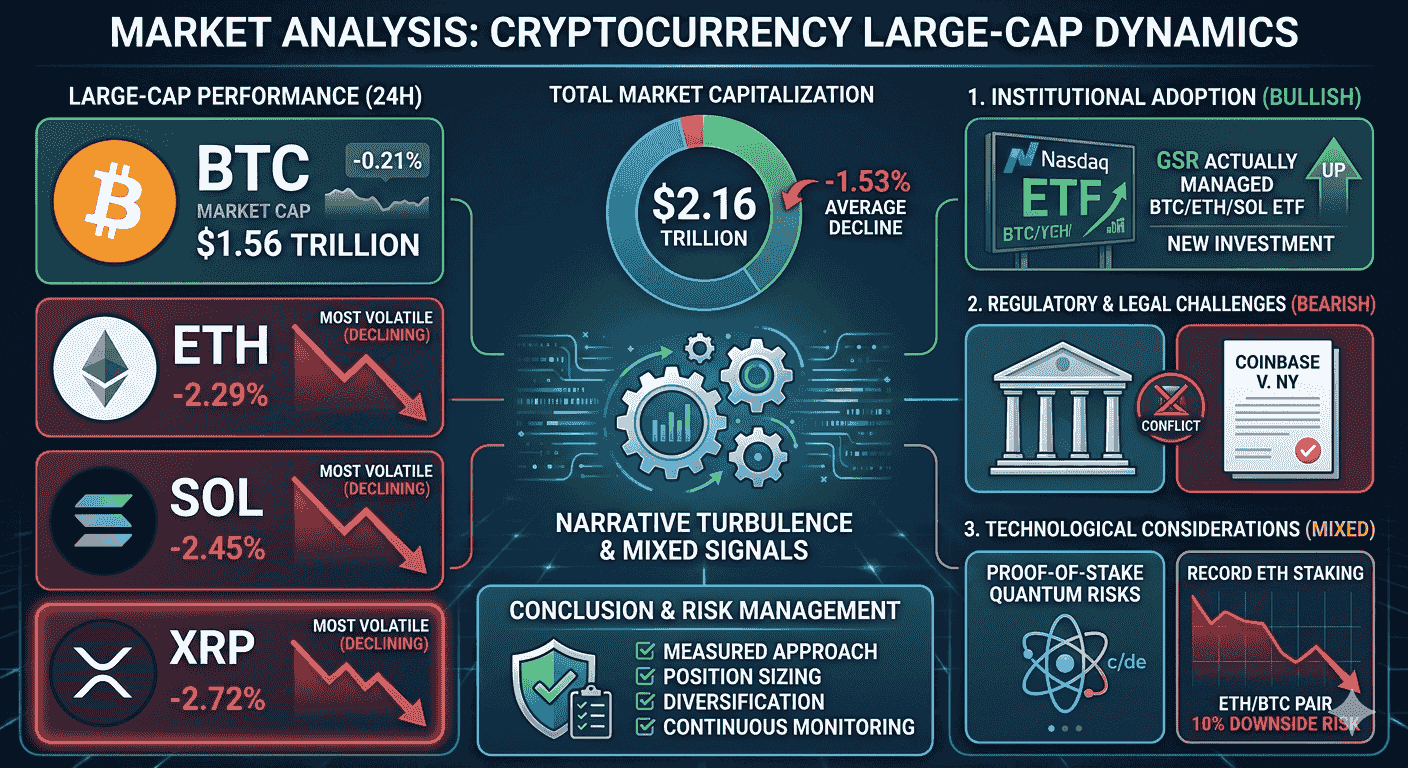
The global cryptocurrency market capitalization stands at approximately $2.156 trillion. This valuation reflects a period where the average 24-hour price change across a snapshot of major assets has been mildly negative, registering an average decline of about 1.53%. This observed short-term bias suggests a cautious sentiment pervading the broader market, particularly within the top-tier assets.
Examining the performance of key assets over the last 24 hours reveals varied but predominantly downward movements:
- Bitcoin (BTC), the largest cryptocurrency by market capitalization at approximately $1.559 trillion, experienced a modest decline of about 0.21%. Its relative stability, compared to some altcoins, often positions it as a bellwether for market health.
- Ethereum (ETH), with a market cap of around $282.5 billion, saw a more pronounced drop of approximately 2.29%. This movement is notable given Ethereum's significant ecosystem and its role in decentralized finance.
- BNB (BNB) recorded a decrease of about 1.26%, while XRP (XRP) posted a decline of approximately 2.72%, making it one of the more significant movers among the top assets.
- Solana (SOL) also experienced a notable downturn of roughly 2.45%.
- Other assets within the top ten by market cap, including TRON (TRX), Lido Staked Ether (STETH), Dogecoin (DOGE), and Wrapped Liquid Staked Ether 2.0 (WSTETH), all registered declines ranging from approximately 1.13% to 2.32%.
- Hyperliquid (HYPE) was an outlier, showing a positive movement of about 0.94% in the same period, though its market capitalization is smaller than many of its top-tier counterparts.
The collective performance of these large-cap assets indicates that while some, like Bitcoin, have shown relative resilience, the broader market has experienced a mild contraction in the short term. This scenario aligns with the observation that the top market-cap basket currently exhibits a mildly negative short-term bias.
Top 3 Most Volatile Coins
In the context of the recent 24-hour period, a closer look at the assets exhibiting the strongest movements can offer insights into areas of concentrated activity or narrative focus. The three most volatile coins among the tracked assets, all registering declines, were:
- XRP (XRP): Experiencing a 24-hour decline of approximately 2.72%, XRP demonstrated the most significant negative price swing among the top volatile assets. With a market capitalization of around $87.26 billion, its movement can attract attention due to its established presence and ongoing regulatory discussions.
- Solana (SOL): Solana recorded a drop of approximately 2.45% over the past day. As a prominent smart contract platform with a market cap of about $49.46 billion, SOL's volatility can reflect broader sentiment regarding high-throughput blockchain ecosystems or specific developments within its network.
- Lido Staked Ether (STETH): Lido Staked Ether saw a decrease of approximately 2.32%. With a market capitalization of around $22.92 billion, STETH's performance is closely tied to Ethereum's staking ecosystem and the broader DeFi landscape. Its movement can indicate shifts in sentiment or activity within liquid staking derivatives.
The concentration of these stronger 24-hour moves in XRP, Solana, and Lido Staked Ether suggests that these assets may be subject to specific market pressures or narrative drivers. While their individual declines contribute to the overall negative bias, their heightened volatility compared to other large-cap assets warrants closer attention, as they could be influencing sector-specific sentiment or attracting trading activity.
Trending News and Market Impact
Recent headlines provide a backdrop for understanding the current market sentiment and price movements, illustrating how external factors and industry developments can influence the crypto landscape.
One significant development highlighting institutional interest is the launch of an actively managed Bitcoin, Ethereum, and Solana basket ETF by crypto market maker GSR on Nasdaq. This move signals a continued push for regulated investment products catering to traditional finance, potentially broadening access and legitimacy for these core digital assets. Similarly, reports from Cointelegraph suggested that a broader crypto market rally was previously attributed to factors like US liquidity measures and record spot ETF inflows, which helped to offset investor concerns over recession fears and geopolitical events. While the market has since shown a mild negative bias, these underlying factors indicate potential drivers for future upside.
On the regulatory and governmental front, the news that the US government runs a Bitcoin node, as revealed by a US Admiral, suggests a potential interest in Bitcoin's underlying technology for network security and protection. While this does not imply direct investment or endorsement, it could be interpreted as a step towards greater understanding or even eventual integration of blockchain technologies at a national level. Separately, Coinbase's decision to shift its New York prediction markets fight to federal court underscores ongoing regulatory battles within the crypto space, particularly concerning the jurisdiction and authority of various government bodies over digital asset activities. These legal and regulatory developments contribute to the ongoing narrative of increasing scrutiny and the evolving framework for cryptocurrency operations.
Technological and protocol-specific concerns have also surfaced. Coinbase's advisory council flagged Proof-of-Stake (PoS) chains, including Ethereum and Solana, as potentially vulnerable to quantum risks, citing concerns over validator signatures and wallet cryptography if future quantum computers can break current encryption standards. While this is a long-term theoretical risk, it introduces a layer of technological uncertainty that could influence investor perception of PoS assets. Furthermore, despite record ETH staking, which reduces liquid supply and could theoretically support price recovery, Ethereum has reportedly risked a 10% decline versus Bitcoin. This highlights that even positive fundamental metrics, such as increased staking, do not guarantee immediate positive price action, as market dynamics are influenced by multiple concurrent factors.
Collectively, these news signals suggest a market reacting to a blend of institutional adoption efforts, persistent regulatory challenges, and evolving technological considerations. The mixed sentiment derived from these headlines, ranging from optimism about new investment vehicles to caution regarding regulatory hurdles and future tech risks, likely contributes to the observed uneven price movements across large-cap assets.
Conclusion and Risk Management
The current cryptocurrency market environment is characterized by a nuanced interplay of factors. The global market capitalization reflects a short-term period of mild contraction, with most large-cap assets experiencing declines over the last 24 hours. Bitcoin has shown relative stability, while Ethereum, XRP, and Solana have recorded more notable downward movements. The strongest short-term moves are concentrated in XRP, Solana, and Lido Staked Ether, indicating specific areas of market attention and potential narrative influence.
Headline news provides a contextual lens, revealing ongoing institutional interest through new ETF launches and broader market rally drivers, alongside persistent regulatory challenges and emerging technological concerns such as quantum risks for Proof-of-Stake chains. These developments contribute to a mixed sentiment that underscores the complexity of the digital asset landscape.
Given these observations, a measured approach to the market is advisable. The presence of both positive catalysts (e.g., institutional products) and potential headwinds (e.g., regulatory uncertainty, technological risks) suggests that conviction should remain tempered. Market participants should acknowledge that while large-cap assets remain the primary lens for assessing market structure, specific short-term movers can highlight areas of dynamic activity.
For risk management, it is prudent to recognize the inherent volatility of the crypto market. Diversification, position sizing, and a clear understanding of individual asset fundamentals and associated risks are essential. The market's reaction to headline-driven catalysts can be swift and unpredictable, reinforcing the need for continuous monitoring and a disciplined strategy rather than reacting impulsively to short-term price fluctuations or news cycles. Understanding that market movements are often the result of multiple, sometimes conflicting, influences can help inform a more resilient approach to engagement with digital assets.
Source Data Reference
Market Snapshot Input
| Asset | Symbol | Price (USD) | 24h Change | Market Cap (USD) |
|---|---|---|---|---|
| Bitcoin | BTC | 77,876.333202 | -0.21% | 1,559,052,105,649 |
| Ethereum | ETH | 2,346.378181 | -2.29% | 282,565,680,271 |
| BNB | BNB | 636.028522 | -1.26% | 88,525,274,963 |
| XRP | XRP | 1.417222 | -2.72% | 87,257,897,827 |
| Solana | SOL | 85.918477 | -2.45% | 49,455,791,080 |
| TRON | TRX | 0.329086 | -1.13% | 28,420,985,731 |
| Lido Staked Ether | STETH | 2,339.886674 | -2.32% | 22,917,783,703 |
| Dogecoin | DOGE | 0.095821 | -1.68% | 14,291,438,421 |
| Hyperliquid | HYPE | 40.91671 | 0.94% | 13,663,242,507 |
| Wrapped Liquid Staked Ether 2.0 | WSTETH | 2,884.961123 | -2.15% | 10,258,145,700 |
Trending Headlines Input
- GSR Launches Actively Managed Bitcoin, Ethereum and Solana Basket ETF on Nasdaq
- Four reasons why the crypto market is rallying today: Will bulls maintain control?
- Coinbase Flags Proof-of-Stake Chains Like Ethereum, Solana as Potential Quantum Risks
- US Government Runs a Bitcoin Node, But Not Mining BTC: US Admiral
- Coinbase shifts New York prediction markets fight to federal court
- Ethereum risks 10% decline versus Bitcoin despite record ETH staking